Okay I say I don’t watch too much T.V. Well, I don’t but there are a few shows I don’t like to miss. Supernatural. Breaking Bad. Smallville (when it was on) and Justified.
Justified stars Timothy Olyphant as U.S. Marshall Raylan Givens, a character created by crime novelist Elmore Leonard. His sparse, in your face style stands beside great crime novelists like Chandler and Dashiell. He died yesterday at the age of 87.
He’ll be missed.
I love his 10 Rules of Writing. Even if you’re not into crime novels, his advice is spot on.
Here’s the list:
Never open a book with the weather
Avoid prologues
Never use a verb other than ‘said’ to carry dialogue.
Never use an adverb to modify the verb said “said.”
Keep your exclamation points under control.
Never use the words ‘suddenly’ or ‘all hell broke loose’.
Use regional dialect, patios, sparingly.
Avoid detailed descriptions of characters.
Don’t go into great detail describing places and things.
Try to leave out the part that readers tend to skip.
I don’t watch a whole lot of television. But over maternity leave, television episodes were the easiest to watch while caring for an infant. One series I always wanted to see but never got around to was Breaking Bad. Last night was the first of eight final episodes. And all I can say is: WOW!
Few television series, or book series, for that matter show the transformation of a character as wells as Vince Gilligan and Bryan Cranston have with Walter White. Comparing the Walter in the first season to fifth season, I was struck by where Walter White has landed. Gone is the meek chemistry teacher fighting the prospect of economic poverty and lung cancer, to become a drug kingpin willing to destroy anyone that gets in his path.
I think what makes this character so intersting is that he didn’t start out evil. He chose to be that way. Life is about choices. And in Walter’s case, very, very bad choices. But it isn’t just the fact that Walter makes good meth or he’s ruethless. His greatest gift is that he lies. He lies so well to everyone. His wife. His drug partner, Jesse. His kids. His brother-in-law, Hank (who’s also a D.E.A. agent). And most of all himself. He even made me convinced too when he told Hank he was just a lolely car wash owner. Then Hank tells him he doesn’t recognize the man Walter has become. Then Walter tells him to ‘tread lightly’.
Oh, my goodness. Just one sentence and Walter tells the entire audience just how he’s changed. It’s also a great hook. I want to see how this story ends. And what happens to Walter. Will the cancer finally catch up to him. Or will someone else finish off Walter before the cancer does? Seven more episodes left in this amazing series.
If you haven’t watched any of this yet and you have Netflix, download it. Or watch AMC. I’m sure they’ll have a marathon of the series again soon.
Most published authors will tell you to read lots and read often. Fiction. Non-Fiction. Anything to keep your mind concentrated on the story. Currently, that’s where I’m at. After reading a couple books on the craft of mystery writing, I closed both of them in irritation. Write sympathetic characters. Write sympathetic plots. While sympathy is an okay word, it wasn’t the RIGHT word.
A scene from the movie Road House kept popping into my head. When one of the bouncers asks their cooler (played by Patrick Swayze) how to respond to an insult, the cooler responds with: “It’s two nouns combined to elicited a prescribed response.” To me sympathy elicits feelings of affection, maybe sorrow brought on by someone sharing their feelings with me. So I care about this person. I have a stake in their welfare. But is this the right word to use to describe how a literary character makes me feel? No. Not really. I think the RIGHT word is empathy.
Here are the two definitions from Word English Dictionary:
Sympathy: n. 1)the sharing of another’s emotions, especially of sorrow, or anguish; pity; compassion.
Empathy: n. 1)the power of understanding and imaginatively entering into another person’s feelings.
Okay. We’ve looked at both definitions. Let’s take the word sympathy head on. Would you offer sympathy to a character like Hannibal Lector, Humbert Humbert, or Dexter after they murder someone? No. You’d be repulsed. You’d empathize—after entering into the minds of these characters you see and understand the reasoning behind their actions. You may not agree with them. But you UNDERSTAND. And that’s what a writer must do. Get the reader to understand your characters. Find them interesting enough to see if they get thrown in the slammer or killed in the same vein as they’ve killed. Words are the atoms of any writing. A wise man once said if you take the words cat house and house cat, they’re the same words but mean two entirely different things. And it’s important to use them correctly and in the right order or as in the cat & house case, you’re liable to get slapped in the face.
One bit of advice Regina Brooks gives in her YA guide book Writing Great Books for Young Adults: Everything You Need to Know, from Crafting the Idea to Landing a Publishing Deal, is to imitate the things you like from other authors (no plagiarizing, though). After replotting my manuscript, I realized I wanted to combine my two stories into one twisted noir. I could have turned to the masters: Hammett, Cain or Highsmith, but I decided to look elsewhere for inspiration.
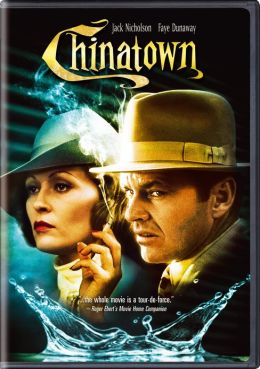
Robert Towne’s Chinatown is one of my favorite movies. While the characters are stereotypical (the private eye, the feme fatal) it’s the story that’s unique. Towne, with Roman Polanski’s vision, takes what appears to be simple matrimonial work for PI Jake Gittes and turns it into a case overflowing with corruption, greed and murder.
I’ve been using Y-writer5 to replot my novel. This program doesn’t have all the bells and whistles of Scrivener, but I can’t complain too much, Y-writer is free. In this post I’m going to show you how I used Y-writer in conjunction with the movie Chinatown to break down a novel scene by scene. I’m also doing this because I love the twisty, turvy plot that’s both intricate and satisfying and I want to see how Towne did it. If you haven’t seen Chinatown, I suggest you STOP reading this post and go watch it (if you have Netflicks it’s streamable). It’s defiantly worth two hours of your time.
Quotes that I love:
Politicians, ugly buildings, and whores all get respectable if they last long enough.
Noah Cross – Chinatown
Forget it, Jake. It’s Chinatown.
Walsh – Chinatown
Y-Writer & Chinatown:
1)Create a project
2)Create your characters (descriptions, back stories, ect)
3)Create a chapter (there were twelve so I went ahead and selected multiple chapter creation)
4)Create a scene
CHAPTER ONE
Scene 1: Curly/husband/client is distraught over the dirty pictures taken of his wife committing adultery . Jake drinking and irritated that he has to do this yet again. Shows Curly out agreeing not to take his last dime to pay for his services. Secretary tells Jake he has another client waiting. Mrs. Evelyn Mulwray with her lawyer. She wants Jake to look into her husband, Hollis Mulwray, believing he’s having an affair. Jake suggests that if she loves her husband to go home and forget about it. Mrs. Mulwray insists she must know. Jake agrees to take the case but hesitant since her husband is a high official. He’s chief engineer for Water and Power.
CHAPTER TWO
Scene 1: Mayor is in favor of building a dam for more water to be available. Council calls on Chief Engineer Mulgrave who states he won’t build it because it’s too dangerous. The crowd erupts in boos. An angry farmer brings his sheep to the meeting to protest the damn and it drying up grazing for his livestock. There’s no water.
Scene 2: Jack follows Mulgrave out to desert valley where damn is sees Mulgrave meet Indian boy. Checks ground and pulls out map and lays it on car.
Scene 3: Jake follows Mulwray watches him from rear view. Gets out and watches as Mulgrave strolls the beach. Stays until dark when water comes gushing out and dumps into the ocean. Follows Mulgrave back. Picks watch out of box. Puts it beneath Mulgrave’s tire.
Scene 4: Ops tell Jake that Mulgrave stayed their all night. Tells Jake the man’s got water on the brain not dames. Photographer shows Jake pictures of Mulgrave and another man and how they got into a huge argument outside a restaurant. Noisy traffic and all the could manage was ‘applecore’. Doesn’t like what he hears. Phone rings and Duff says he found Mulgrave with a lady.
CHAPTER THREE
Scene 1: Taking pictures of Duffy so he can get ones of Mulwray with young girl. Location: Echo park on pond.
Scene 2: Follows Mulwray. Inside is a courtyard. Mulwray is meeting a pretty blonde girl who speaks Spanish.
Scene 3: Reading paper and getting a shave. Jake and mortgage broker get into it regarding Jake’s profession.
Scene 4: J. tells Sophie to leave for a moment so he can tell a crass joke. Opps are trying to say something but he’s more interested in telling his joke. Door opens behind him and a sharp dressed woman and another man steps out. Strange woman introduces herself as the real Mrs. Mulwray and that she’s never met him or hired him to spy on her husband. Mrs. Mulwray threatens him with her attorney.
CHAPTER FOUR
Scene 1: Goes to Gittes office and his secretary tells him he’s not in. Invites himself into Mulwray’s office to look around. Looks around and sees pictures of real Mrs. Mulwray. Finds a plat map but is interrupted by the assistant who escorts him into his office. Jake takes one of his cards. Runs into some competition who is guarding the building because of the threats.
Scene 2: Goes looking for Mulgrave at his house. Only finds Mrs. Mulwray. She agrees to drop the lawsuit. She doesn’t know where her husband is and seems like she’s hiding something.
Scene 3: Jake uses Mulgrave’s assistant’s card to get through guards at dam. Meets old friend name Louis Escabar whom he used to work with in China town that is now a lieutenant who’s a lieutenant. The cops are there because Mulgrave is dead.
CHAPTER FIVE
Scene 1: Mrs. Mulgrave comes down to id the body. Louis/lieutenant asking her questions about Melgrave taking his own life. Admits that her husband was seeing girl and they quarreled over. Came as a surprise. Lieutenant things it’s odd since she hired Jake. Jake walks her to her car amid the press. Mrs. Mulwray says she’ll send him a check to make it official that she hired him.
Scene 2: Coroner states Mulwray died of drowning in a the middle of a drought. Asks about other guy. Homeless. Also drowned in LA river. Jake says that’s strange because there’s absolutely no water.
CHAPTER SIX
Scene 1: Jake visits the L.A. riverbed mostly rocks and very little water. A Mexican boy tells him the river comes but on different parts.
Scene 2: Jake visits the dam at night where Mulwray’s body was found. Scales a fence. There’s gun shots then water rushes down the damn taking Jake with it. He climbs the fence again to escape it. Runs into some shady fellas that cut his nose and tell him to stop being so nosy.
Scene 3: Discussing what happened to him at the dam. Gets a mysterious call from the woman that was pretending to be Mrs. Mulwray. She says she never intended for anything nasty to happen. Tells him to look in the obits for ‘one of those people’.
Scene 4: Jake at diner checking out obits in newspaper. Sees that the bond for the new dam passed. Mrs. Mulwray shows up. Jake is asking questions about her and her relationship with her husband. She gets defensive about asking him questions about her past. Jake thinks it’s strange that she was glad about the affair. It goes contrary to what he’s seen. Still thinks she’s hiding something even more so that she won’t tell him where she was on the night her husband was killed. Outside he wants her to come with him get more info out of her. He tells her all the things that he believes why her husband was murdered. And he makes a point to tell her again that she’s hiding something. Jake gets in his car. Mrs. Mulwray is almost close to tears. She shouts out Jake’s name but he has already squealed away.
CHAPTER SEVEN
Scene 1: Visits assistant engineer’s office. See’s Noah Cross’ photo on wall. Wonders if it’s a relation to Mrs. Mulwray’s. Sits and waits for assistant engineer. Learns that Hollis and Cross worked together and that Cross once owned the entire water supply to the city. Learned that Hollis and Cross were partners. In assistant’s office, accuses him of hiring chip to hire him to frame Hollis for a scandal so they could get rid of the opposition to build the new dam. Assistant engineer states that they’ve been diverging water to orange groves up north hoping to help the farmers out. This doesn’t sit right with Jake.
Scene 2: Jake return to find Mrs. Mulwray in his office. She offers him a huge advance if she finds out who killed her husband and who’s behind it. When Jake mentions Noah Cross, Mrs. Mulwray is physically agitated. She says Hollis and her father had a falling out regarding the dam that broke. She stated that Hollis and her father never spoke again after that. Jake knows that’s not true because his ops got pictures of the two of them talking.
Scene 3: Arranges a meeting with Noah Cross. He’s asking him questions about his daughter and warns Jake that his daughter is disturbed and he shouldn’t be getting involved with her. Offers Jake double what his daughter is offering if he finds Hollis’ girlfriend. Noah avoids discussing what Hollis and him were meeting. Arguing over their daughter. Insistent on finding Hollis’ girl.
CHAPTER EIGHT
Scene 1: Visits the hall of records. Discovers that most of the land in the valley has been sold in a couple of months. Steals plot map out of book.
Scene 2: Visits one of the lots that was sold. It’s try with a dried up river running through it. Makes his way to the orange groves where he was told the water had been diverged. There’s a big no trespassing sign posted, but Jake goes on the property anyway. Get’s caught by the proprietor who tells him that Mulwray is the the one who’s been poisoning his wells and trying to get him to sell, which he won’t. Jake and the hired hands get into it and they end up knocking Jake out.
Scene 3: Jake wakes. The proprietor and his wife look at him while Mrs. Mulwray looks over him. She gives him a ride back to town because his car is wrecked. Tells Mrs. Mulwray that the dam is a con job. It’s not going to go to L.A. it’s going to the valley. Learns that dead people in the obits are the one’s buying up the land.
Scene 4: Use a fake reason to look around rest home. Find all the names that are on the deeds. None of the elderly know they’re rich people. Jake talks to one of the ladies that owns the land. They’re making a quilt. A piece of it catches Jake’s eye. The lady says its from the Albecore club. They treat everyone very nice. Mr. Palmer interrupts and says there’s someone there to talk to him. Jake beats up the goon and gets in Mrs. Mulwray’s car and drives away.
CHAPTER NINE
Scene 1: Tensions are high from the chase. Jake and Mrs. Mulwray end up in bed together. Pillow talk until the telephone rings. Mrs. Mulwray says she has to leave. Right now. She confesses that her father owns the club. She gets very agitated when he speaks of her father. They quarrel over her father and the girlfriend. Mrs. Mulwray warns him about her father. He agrees to wait for her, but it’s a lie. Jake decides to follow her.
Scene 2: Jake follows her to two story house in L.A. At the back of the house sees her with the butler from the house arguing over a newspaper. Hears a girl crying. It’s Hollis’ girlfriend. She’s speaking Spanish. Distraught and Mrs. Mulwray is trying to comfort her. Jake is there waiting for her in her car. She confesses that girl is her sister and that she really did care for Hollis. She asks him to come back to the house with her. Jake says he’s had enough for one evening.
Scene 3: Jake is cleaning up and going to bed. Get’s a phone call from a guy that tells him the fake Mrs. Mulwray wants too meet him in Echo Park. Jake tells the guy Ida Session can call him at the office. The man calls again, but Jake doesn’t go.
CHAPTER TEN
Scene 1: Apartment guy told him about the previous night. Finds Ida Sessions murdered. The kitchen in a mess. Finds Louis in the bathroom with another cop. Ida has the photo’s he took of Hollis and the girl. Louis thinks he’s an accessory after the fact and that he and Mrs. Mulwray are in it together. Jake says no. Hollis was killed because of the valley/water/dam.
Scene 2: Go to ocean front where Hollis’ body was found. The police interview assistant engineer and they said they’re only dumping run off. Gittes says they’re lying. Louis tells him he’s lying. Louis gives Jake two hours to get Mrs. Mulwray to his office.
Scene 3: The servants are packing up the house and no one seems to know where Mrs. Mulwray is. Jake takes a look around. Gardner tells him salt water is bad for grass. Pound is full of salt water. Discover Hollis’ glasses in the pond.
CHAPTER ELEVEN
Scene 1: Finds Mrs. Mulwray, butler and girl at the house getting ready to leave. Jake confronts her with the glasses of Hollis’ he found. Wants her to tell him the truth before cops get there. Jake beats the truth out of her. Hollis’ girl’s name is Kathrine. She’s Mrs. Mulwray’s daughter/sister. She ran away to Mexico to have her at fifteen. Hollis followed her to help her. Mrs. Mulwray tells him now she wants to protect her daughter. Jake tells her she need to leave. She also tells him the glasses weren’t Hollis’. He didn’t wear bi-focal. Butler takes both of them to his place. Calls opps at office and tells them to meet at Kahn’s place in two hours. Jake tells Louis that Mrs. Mulwray flew the coop. The maid should know where she is and lives in San Pedro. Louis says he has to go with him to the maid’s house.
Scene 2: Maid’s house happens to be Curly’s. Cheating wife has a shiner. Jake asks Curly to give him a ride somewhere to get away from the cops.Curly agrees to take the Mulwray’s to his boat and get them out of town. Jake calls Cross and tells him he has the girl. Cross agrees to meet him in an hour.
CHAPTER TWELVE
Scene 1: Cross comes. Insistent on knowing where the girl is. Jake confronts him and accuses Cross of killing Hollis. Cross tells him that he plans on annexing all the land into the city. Bring L.A. to the water. cross says at the right place and the right time people are capable of anything. Takes the glasses from Jake and depends they take him to the girl who he says is the only daughter he has left.
Scene 2: Driving toward China town. Louis is there. Jake is trying to tell him that Cross is the one that killed Hollis. He’s an evil man and should be the one they’re after. Cross goes after Kathrine. Evelyn tells Cross to stay away from her. Evelyn shoots cross and speeds away. The cops fire at the car. Evelyn is hit and killed. Cross takes Katherine. Louis orders Jake’s ops to take him home. Jake stops to protest but his ops tell him to forget it.
There are so many great things a writer can take away from this show. Somehow, I managed to narrow them down to six. And here they are:
1) TREAT YOUR CHARACTERS LIKE THEY’RE FAMILY: The premise of the show is two brothers driving across the back roads of the United States in their 1967 Impala, and battling the things that go bump in the night. You have the good son, Dean, who enjoys hair bands, fast cars, and faster women. Then you have the younger brother, Sam, the rebellious one who ran away to college to get away from the ‘family business’ only to jerked back in when his girlfriend is brutally murdered. Family is important to everyone and nothing brings out the worst in people than being stuck in a tin can for miles on end. Great premise and it’s had me hooked since the first episode.
2) KNOW WHERE YOU’RE GOING (PLOT WISE): A lot of series start out with a pilot or a first book and don’t really know where they’re going. They kinda stumble around in the dark hoping they hit upon the right path. Not Supernatural. Eric Eric Kripke, the creator, had a plan for five seasons. And man was it a plan. The first scene in Lawrence, Kansas was the pin that held it all together. In the middle of the night, a stranger appeared in Sam’s room. Why? Then season after seaon you watch as all the pieces come together in a dramatic and satisfying way. I love it when things come full circle.
3) WRITE GREAT DIALOGUE: Television relies on the things you can see and hear. This is just one of the aspects of great fiction too. Dialogue must enhance the plot and characterization simultaneously. This is where this show really shines. Pop-culture infused fun. Here are some of my favorite lines:
– From Season (1), Episode (1), “The Pilot” Sam: When I told dad I was scared of the thing in my closet he gave me a .45. Dean: What was he supposed to do? Sam: I was nine years old. He was supposed to say don’t be scared of the dark. Dean: Don’t be afraid of the dark? Are you kidding me? Of course you’re supposed to be afraid of the dark. You know what’s out there. – From Season (1), Episode (11), “Scarecrow” Dean: [To the scarecrow] Dude, you fugly. – From Season (3), Episode (11), “Mystery Spot” Dean: [after Sam tells Dean he saw him get hit by a car] And? Sam: And what? Dean: Did it look cool, like in the movies? Sam: You peed yourself. Dean: Of course, I peed myself. Man gets hit by a car, you think he had full control of his bladder? Come on!
– From Season (3), Episode (12), “Jus in Bello” Henricksen: I shot the sheriff. Dean: But you didn’t shoot the deputy.
– From Season (4), Episode (22), “Lucifer Rising” Dean: I’m not sure if he’s my brother any more. If he ever was. Bobby: You stupid, stupid son of a bitch! Well boo hoo. I am so sorry your feelings are hurt… princess! Are you under the impression that family’s supposed to make you feel good? Make you an apple pie, maybe? They’re supposed to make you miserable! That’s why they’re family.
– From Season (5), Episode (1), “Sympathy for the Devil” Sam: So let me ask the million dollar question: What do we do now? Bobby: Well, we save as many as we can for as long as we can. It’s bad, and whoever wins, Heaven or Hell, we’re boned. Dean: What if we do win? I’m serious. Screw the Angels and the Demons and their crap apocalypse. Now if they wanna fight a war, they can find their own planet. This one’s ours, and I say they get the hell off it. We take ‘em all on. We kill the Devil, hell, we even kill Michael if we have to, but we do it our own damn selves. Bobby: And how are we supposed to do all this genius? Dean: I got no idea. But what I do have is a GED and a give-em-hell attitude and I’ll figure it out. Bobby: you are nine kinds of crazy boy. Dean: It’s been said.
4) APPRECIATE YOUR AUDIENCE: You gotta stay connected to your fans whether it’s through email, snail, or through the numerous outlets of social media. This show pays homage to their fans in a number of ways. One of the best examples is episode 18 of Season 4: “The Monster at the End of this Book”. The writers incorporate/mention real life online slash fan-fiction into this episode’s storyline. Sam and Dean stumble across a cult book series written by Carver Edlund, a pseudonym for Chuck Shurley who’s writing the story of Sam and Dean. Castiel, the angel, informs them Chuck is actually a prophet and that he’s writing what will become the Winchester Gospel.
5) DON’T TAKE YOURSELF TOO SERIOUSLY: A writer must be humble and above all don’t take themselves too seriously. In episode 15 from Season 6 “The French Mistake” the writers do just that. Sam and Dean become Jensen Ackles and Jared Padalecki, a television show called ‘Supernatural’ about their life. What’s so humorous is that the last character to play the infamous Ruby (Genevieve Nicole Cortese Padalecki), is actually married to Jared in real life.
6) KNOW WHEN TO CALL IT QUITS: This is the one thing Supernatural hasn’t done. I really believe the writers should have ended this series after season five. Writers too fall prey to the money instead of the story. For goodness sake, tell the story then let it go. Move on to something else. It’s better to go out with a bang than peter out with a fizzle.
I just finished How to Write Killer Historical Mysteries and I thought I’d discuss outlining. Now, I outline. I need a map. It’s usually a chapter by chapter sketch of the POV, general setting, and what I want the chapter to accomplish. Usually, I have the first 1/4 and the last 1/4 of the book outlined in my head. It’s always the middle 1/2 where I have trouble. It comes eventually, though.
Not everyone outlines. Kathy Emerson outlines as she goes. Benjamin Leroy, founder of Tyrus Books, consideres himself a ‘pantser‘. Meaning he says to ‘hell with it’ and simply writes what flows from his fingers. I admire the writer who does this. My brain simply doesn’t work that way.
The outline of He’ll Bring You All Down (my new YA novel) is about 3/4 complete with about 1/4 written. There’s still some kinks I have to work out in the first draft, but I’m getting there.
I’m in the process of revising several chapters before I submit my manuscript to a development editor. I kept returning to the most important chapter. Chapter One–and I didn’t like it. I felt I wasn’t hooking my reader fast enough. Yet, I wasn’t sure what to do with it. Then one afternoon, while reading one of my ex-critique partners blogs, I noticed she’d recommended a book by Less Edgerton.
Edgerton provides a list of essentials for any first chapter:
1)Inciting incident (no. 1 MUST lead to no. 2)
2)Initial surface problem (All of them must lead to no. 3)
3)Story-worthy problem (If you don’t have one of these, you don’t have a book)
4)Set Up
5)Back story
You must blend all five of these requirements (1, 2, 3 are the most important) together in an action scene. If done right, and begun in the right place, he insists your first chapter should ‘grab the reader and never let them go’.
My main problem was I hadn’t begun my story in the right place. Once I found where that was, I was able to use all of Edgerton’s points to fix my issue. Now, I certainly like where my first chapter begins. But that doesn’t mean I won’t revise it again 😉
After converting my Nook to an Android tablet, I began perusing the Google Play store for productivity apps. I wanted something I could sink with Dropbox and not have to worry about juggling around my flash drive (not using the laptop so the flash drive is kinda moot at this point).
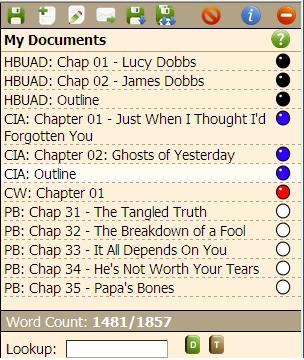
If you’re looking for a writing app that doesn’t have too many bells and whistles, try My Writing Spot. It’s available for download with both Ipad/Iphone and Android. You can also use its website and sink what you write on the website to the app on your device (make sure you have a wi-fi connection and a gmail account handy).
The app is simple. No formatting to get in your way. You just type. You can title your sections whatever you want and group them together by colors. Once grouped, the app syncs them together and provides you a total word count. A handy dictionary and thesaurus is also provided. So, so long www.dictionary.com.
The only glitch I’ve found in the program concerns titling sections. The app allows only so many characters. But the website has no restriction. To bypass this restraint, I’ve just been retitling it on the website and synching it later.
Oh, and as for the Nook Color running Android’s Gingerbread, it’s working great. The small keyboard is an adjustment, but well worth it. The only flaw in the whole system I’ve noticed is you have to take the device out of usb host mode for it to charge correctly.
Things have been crazy busy with a new baby. The only time I’ve found to write is when he’s sleeping. My laptop and Alphasmart keyboard are too cumbersome. Even my husband’s Ipad is just too big. So I’ve made due with the Nook Color–and it’s fine, but all you can do is hunt and peck and it makes for excruciatingly slow writing.
As an E-reader, the Nook Color works great, but it has limitations. I have an Amazon account with a few Kindle books and I can’t read them on my Nook. The Nook app store is terribly lacking. Much more so when compared to the Google Play store or Apple store. After doing some research, I discovered I could turn my Nook Color into an Android tablet running on Android Gingerbread.
I thought about rooting the Nook myself. I’m computer-savy, but I didn’t have the time. Nook to Android will do the rooting for you (for some cash), and you don’t have to worry about voiding your warranty or ‘bricking’ your Nook. Once I received the SD card, the installation was fairly simple. I slipped the card into the SD slot. Followed the directions provided, and in less than five minutes, I was downloading apps from Google Play and accessing my writing via Dropbox. I also purchased a keyboard and a USB connector I purchased from Radioshack (Just a word of caution here. Don’t order the SD card off of the developer’s website. They haven’t developed a kernel for Android 4.1 (Jellybean) yet so your keyboard won’t work). To link my Nook to my keyboard, I then downloaded the free app: Nook Tweaks or USB Host Controler (To get the keyboard and Nook to work together try visiting this site).
So far, I’m impressed. And I don’t have to lug around my heavy laptop anymore.
Secondary characters don’t have to be people. They can be animals too. In my novel Papa’s Bones, my lead character has basset hound named Simon. By letting my main character have a dog, I can show her capacity for loyality and responsibility without having to resort to telling. I chose a basset hound for two reasons: 1)The breed attributes blended well with my main character 2)I was writing what I knew.
Living with Bella (that’s her to the left) is like having a permanent toddler with O.C.D. Just when I think I’ve learned where the invisible line is on my counter, I hear a crash and rush into the kitchen. There she is wiggling with glee trying to root open a bag of potato chips. I have to remind myself not be angry. After centuries of genetic experimentation, she’s a dwarf with an olfactory system ten million times stronger than mine.
Other than the bloodhound, basset hounds have the second strongest nose in the canine world. Their droopy ears, sagging eyes, and loose wrinkly skin turn them into one determined sniffing machine. They latch onto a smell and nothing else matters.
When developing secondary characters go beyond stereotypes. Delve farther into your imagination. And sometimes the best examples are those right in front of you.
 Okay I say I don’t watch too much T.V. Well, I don’t but there are a few shows I don’t like to miss. Supernatural. Breaking Bad. Smallville (when it was on) and Justified.




 L.M. Elm, Historical Novelist