Blog

Reviews

2026 Reading Challenge

Private Detectives in Fiction

My current manuscript features a female private investigator trying to uncover who—or what—is behind a string of car vandalisms at a country club in 1937 Des Moines, Iowa.

Querying my latest novel has prompted me to reflect on the legacy of private investigators in fiction. Many believe Edgar Allan Poe introduced the first fictional private investigator in his short story The Murders in the Rue Morgue (1841). For the next fifty years, male characters dominated the genre until Catherine Louisa Pirkis introduced Loveday Brooke, a female detective, in 1894.

The Golden Age of Detective Fiction spans three decades (1930s–1950s). This era introduced hard-boiled detectives, inquisitive elderly women, and morally ambiguous individuals who solved crimes in unconventional ways.

Although the Golden Age has passed, others and I continue to revive the genre with fresh and inventive twists. This year, I’m paying tribute to past and present authors who celebrate my favorite genre.

The Rules

  1. Must have a detective in the story (The character may not think they’re one, but they must be in search of a crime).
  2. Each book much be from a different decade (1890s-2020s).
  3. Post reviews (Substack & website).

Books:

  • The Experiences of Loveday Brooke, Lady Detective by Catherine Louisa Pirkis (1894).
  • The Clue by Carolyn Wells (1909).
  • The Capture of Paul Beck by Matthias McDonnell Bodkin (1911).
  • The House Without a Key by Earl Derr Biggers (1925).
  • The Conjure-Man Dies by Rudolph Fisher (1932).
  • The Case of the Buried Clock by Erle Stanley Gardner (1943).
  • Killer Inside Me by Jim Thompson (1952).
  • A Stranger in my Grave by Margaret Millar (1960).
  • Skinflick by Joseph Hansen (1979).
  • Indemnity Only by Sara Peretsky (1982).
  • Blanche on the Lam by Barbara Neely (1992).
  • Still Life by Louise Penny (2005).
  • Don’t Dare a Dame by M. Ruth Myers (2013).
  • The Princess & the P.I. by Nikki Payne (2025).
Iowa History

Streamline Moderne in Des Moines, Iowa (1930s)

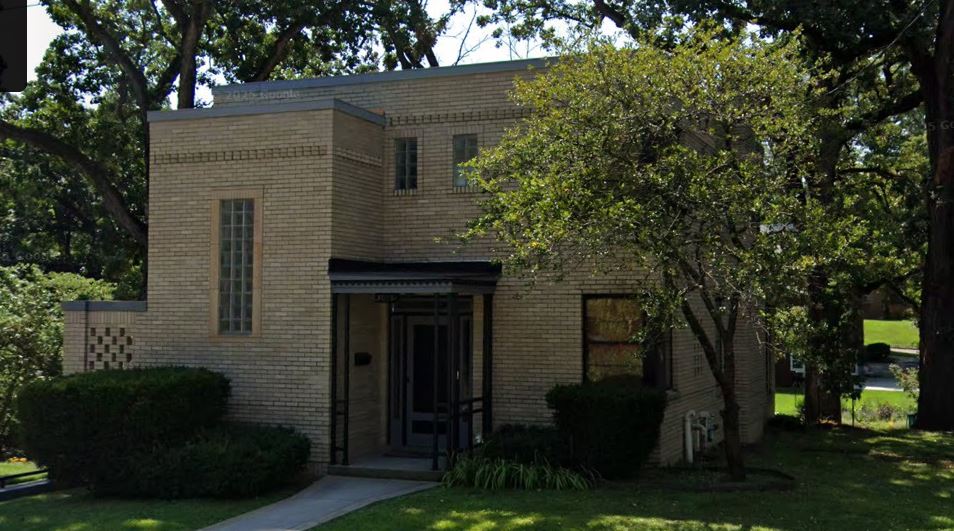
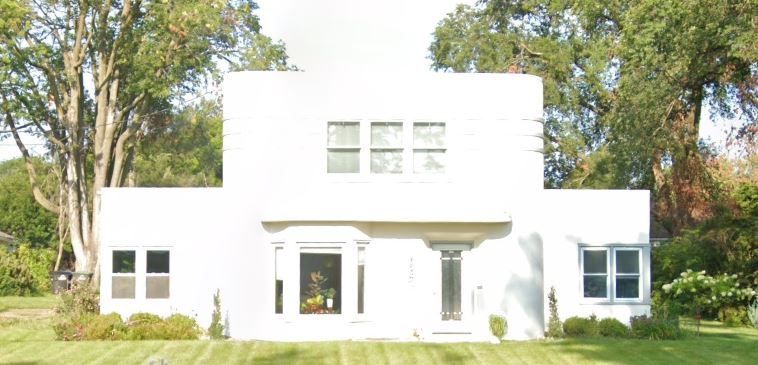
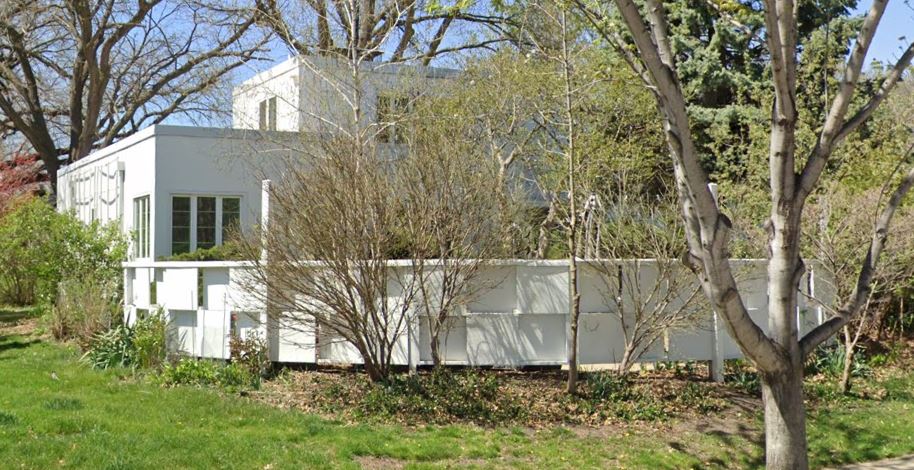
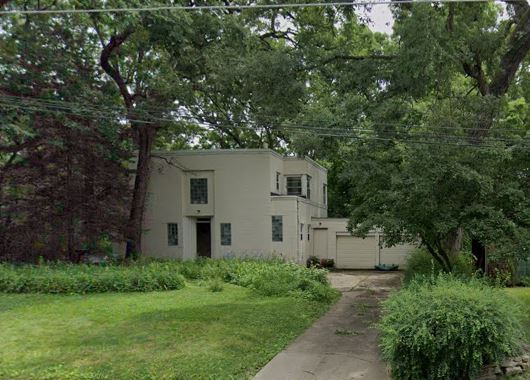
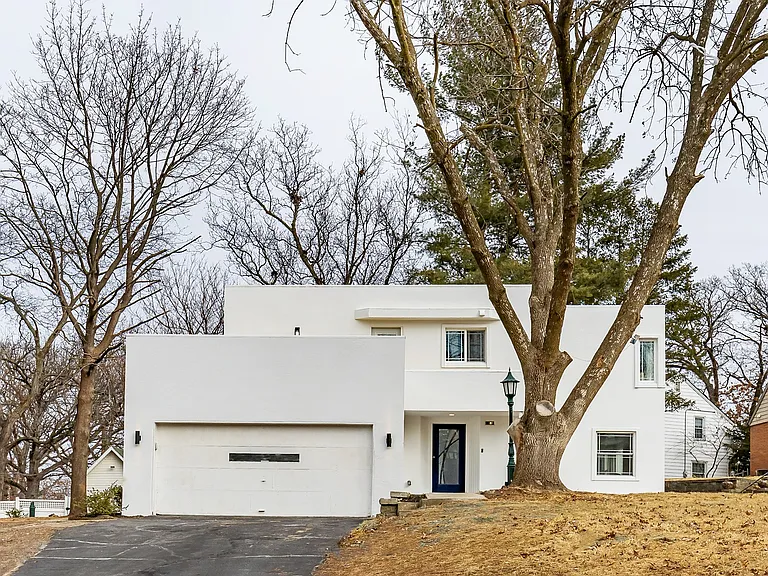
One of the most common architecture designs of the 1930s was Streamline Moderne. Art Deco’s less flashier cousin, it features designs and materials like stucco, chrome, straight-lines, rounded corners, and glass.

4028 Ovid Avenue (1939):

4028 Ovid Avenue, Des Moines, Iowa, 50310.” Google Earth. October 2022. Accessed: 30 August 2025.

The land in Ashby Woods was originally owned by Newton B. Ashby and B.C. Hopkins. In the 1920s, developers parceled off the land, advertising the area as having many trees and being close to Beaverdale and local schools. The neighborhood was subject to restrictive covenants: only a white person could purchase a lot and build a house with as little as $50 down and 1% interest.1

3940 Beaver Avenue (1939):

3940 Beaver Avenue, Des Moines, Iowa, 50310.” Google Earth. August 2024. Accessed: 30 August 2025.

The Hoyt Sherman Trust Estate began parceling off land in Kimble Acres in 1912. Located at Beaver and Douglas Avenues, real estate agents advertised easy access to the area via main roads (Beaver and Douglas) and close proximity to the Urbandale streetcar. Buyers could purchase a tract with no interest, no taxes, just $10 down and a small monthly payment. The advertisements did not specify whether the area had restrictive covenants.2

1900 44th Street (1939):

1901 44th Street, Des Moines, Iowa, 50310.” Google Earth. April 2024. Accessed: 30 August 2025.

The property was originally owned by the Hickman family. The original 160 acres were parceled and sold, with Hickman Acres being one such section platted in 1922. Developers advertised the area as “Acreage for Modern Homes.” The land was well-drained and had sewer, electricity, and easy access via the paved Hickman Avenue. It was also close to Perkins Elementary School, a high school, colleges, and churches. Buyers could purchase a lot for $10 down, $10 a month, with 6% interest. Guy B. Brunk was the realtor. The advertisements did not indicate whether the area had restrictive covenants.3

4816 Grand Avenue (1937):

4816 Grand Avenue, Des Moines, Iowa, 50312.” Google Earth. July 2024. Accessed: 30 August 2025.

This tract of land was developed by L.P. Brown of Des Moines in 1923. It was bordered by Grand Avenue to the north and Greenwood Park to the east. Advertisements labeled the division “Westwood.” Selling points included Greenwood Park, close proximity to Roosevelt High School, and access to the Ingersoll streetcar loop. The area was subject to restrictive covenants.4

2027 Nash Drive (1938):

2027 Nash Dr., Des Moines, Iowa, 50314.” Zillow. 2025. Accessed: 30 August 2025.

The property was originally used to house visitors and entertainers during the early days of the Chautauqua circuit. Des Moines College purchased the land for development prior to World War I, then sold it to a St. Louis developer in 1923. The area was subject to restrictive covenants.5

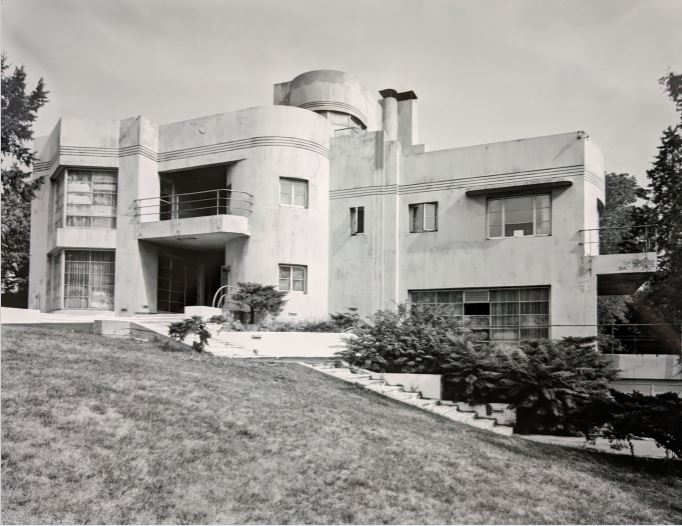
2633 Fleur Drive (1934):

Butler Mansion Press Photo. Lisa Taber Collection.

H.S.M. said of this house in 1935, “A 19-gun salute to Earl Butler and the modernistic house he’s building—that’s the sort of pioneering we need right now.” Earl Butler wanted a home that would withstand the Iowa elements and be economically sound. Some of the amenities this house provided were heating, air conditioning, a freezer, a refrigerator, and an ‘electric eye’ for opening each of the three-stall garages. The house also had a ramp connecting all three floors to limit accidents on stairs. Today, the Butler mansion is home to the Italian American Cultural Center of Iowa.6

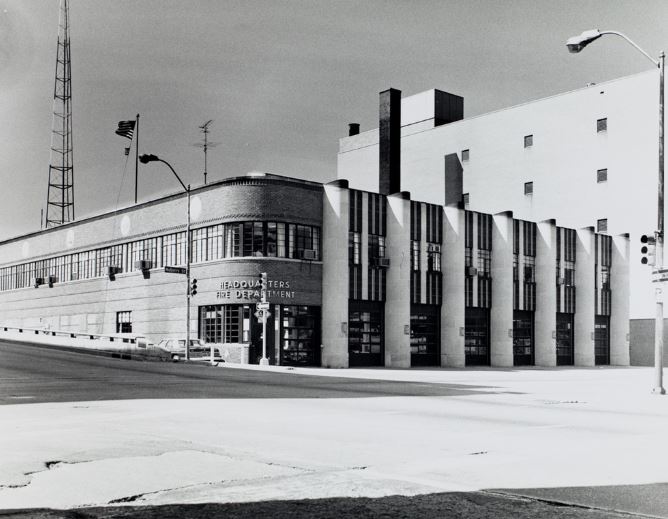
900 Mulberry Street (1937):

Fire Department Headquarters.” Image owner David Gebhard and Gerald Mansheim. “Fire Department Headquarters.” Society of Architectural Historians. 2025. Accessed: 30 August 2025.

The old Lincoln Grade School was demolished in favor of a “modern structure” in the 1920s. Until the fire department headquarters was built, the property served as a parking lot, generating revenue for the city. The headquarters, designed by Proudfoot & Rawson, was part of the New Deal’s Public Administration project.7

Additional Sources:

Sources:

  1. 4028 Ovid Avenue.” Polk County Assessor. Des Moines, Iowa. 2005. Accessed: 30 August 2025. “Going Fast!Des Moines Tribune. Des Moines, Iowa: 27 May 1927, 35. “Lots for Sale.” Des Moines Register. Des Moines, Iowa: 15 July 1934, 50. “Rain Delay Opening.” Des Moines Tribune. Des Moines, Iowa: 13 May 1927, 5. ↩︎
  2. 3940 Beaver Avenue.” Polk County Assessor. Des Moines, Iowa. 2025. Accessed: 24 May 2025. ”City’s Business, The.” Des Moines Register. Des Moines, Iowa: 2 April 1924, 5. “Kimble Acres.” Official Plat of the South 1/2 of the S.E. 1/4 of Section 19 T. 79. R24. 27 June 1912. Polk County Accessor. Accessed: 30 August 2025. ”Kimble Acres.” The Register and Leader. Des Moines, Iowa: 11 May 1913, 6. ”Real Estate Transfers.” The Register and Leader. Des Moines, Iowa: 19 February 1913, 9. ↩︎
  3. 1900 44th Street.” Polk County Assessor. Des Moines, Iowa. 2005. Accessed: 30 August 2025. ”Don’t Fail to see Hickman Highlands.” Des Moines Tribune. Des Moines, Iowa: 05 May 1922, 25. “Hickman Highlands an Official Plat of the N.E. 1/4 o f the N.E. 1/4, of Section 31, Twp. 79N., R. 24W of the 5th P.M. Iowa.” 25 April 1922. Polk County Accessor. 2025. Accessed: 30 August 2025. McLaughlin, Lillian. ”Charming Old Home on ‘Hickman Farm’.” Des Moines Tribune. Des Moines, Iowa: 01 July 1967, 18. ”See Hickman Highlands.” Des Moines Tribune. Des Moines, Iowa: 25 April 1922, 17. ↩︎
  4. 4816 Grand Avenue.” Polk County Assessor. Des Moines, Iowa. 2025. Accessed: 24 May 2025. “L.P. Brown Dead at 78.” Des Moines Tribune. Des Moines, Iowa: 18 June 1958, 16. ”L.P. Brown’s Official Plat of Lot 1 Westwood, Section 12, 78-75.” 22 March 1923. Polk County Accessor. Accessed: 30 August 2025. ”West End.” Des Moines Register. Des Moines, Iowa: 03 June 1923, 36. ”Westwood.” Des Moines Register. Des Moines, Iowa: 25 November 1923, 44. ”Westwood.” Des Moines Register. Des Moines, Iowa: 19 April 1924, 11. ”Westwood.” Des Moines Register. Des Moines, Iowa: 15 June 1924, 51. ↩︎
  5. 2027 Nash Drive.” Polk County Assessor. Des Moines, Iowa. 2025. Accessed: 24 May 2025. Elm, L.M. “Land Deed Restrictions (1930s).L.M. Elm, Historical Novelist. 24 April 2022. Accessed: 30 August 2025. ↩︎
  6. H. S. M. “Over the Coffee.” Des Moines Register. Des Moines, Iowa: 25 June 1935, 16. “House for Earl Butler, Des Moines, Iowa.” Architectural Forum 67, no. 3 (1937): 179–86. Bolten, Kathy A. ”Italian American Cultural center of Iowa Purchasing Iconic Butler Mansion for $3.3 Million.” Business Record. 20 December 2020. Accessed: 20 April 2020. ↩︎
  7. “City Clears Way for New Fire Station.” Des Moines Register. Des Moines, Iowa: 06 January 1937, 13. ”Des Moines Social Club Headquarters.Iowa Architectural Foundation. Des Moines, Iowa. 2025. Accessed: 30 August 2025. ”Farewell to Old School.” Des Moines Tribune. Des Moines, Iowa: 25 April 1924, 12. ↩︎
Reviews

2025 Reading Challenge

I have three out of the ten in my collection, the rest I’ll have to either interlibrary loan or purchase.

I like to start each year with a reading goal. For example, last year I focused on historical mysteries published within the last five years to get me in the mood for adding applicable comps to my upcoming query (I found two great ones BTW).

Rules for 2025 Reading List:

  1. The movie must be an adult book adaptation.
  2. If I’ve watched the movie, I can’t have read the book.
  3. If I’ve read the book, I can’t have watched the movie.
  4. The movie premiered in the same decade the book was published.
  5. Read the book and watch its movie adaptation from 1920 – 2019.
  6. Post reviews of the book & movie on Substack, & my reviews page.

Reading List:

BookPublication DateMoviePremiere Date
The Wind1925The Wind1928
Gone With the Wind1936Gone With the Wind1939
Mildred Pierce1941Mildred Pierce1945
Peyton Place1956Peyton Place1957
Rosemary’s Baby1967Rosemary’s Baby1968
Jaws1974Jaws1975
Less Than Zero1985Less Than Zero1987
Devil in a Blue Dress1990Devil in a Blue Dress1995
Mystic River2001Mystic River2003
Light Between Oceans2012Light Between Oceans2016

Research

The Profane Angel

Carole Lombard in 1936. Everett Collection

I started out wanting to do a post about profanity in the thirties (sorry Lucille Bogan I’ll make a post about your salty lyrics later, I promise). However, I found myself falling down a rabbit hole. In this case, the white rabbit was Carol Lombard.

According to Fred Peters, Carol’s brother, she developed her blue vocabulary working for Pathe Studios in the 1920s. For her, it was a means of leveling the playing field with her male costars. Margaret Tallichet Wyler called it Carol’s ‘work jargon’ claiming she never heard Carol swear in front of her mother.1

There’s a gag real of My Man Godfrey. It’s great catching a glimpse of her, William Powell, and other stars swearing and goofing around.2

Carol Lombard made 56 feature films.3 She was a keen businesswoman who knew her way around contracts. For a time she was one of the highest paid actresses in Hollywood. She lost her life in 1942 when the plane she was traveling in while selling war bonds crashed into Nevada’s Mt. Polosi.4

Carol’s 10 Rules for Living By a ‘Man’s Code’5

  1. Play Fair
  2. Don’t Brag
  3. Obey the Boss
  4. Take Criticism
  5. Love is Private
  6. Work–And Like It!
  7. Pay Your Share
  8. The Cardinal Virtue–Sense of Humor
  9. Be Consistent
  10. Be Feminine

SOURCES:

  1. Robert Matzen. Fireball: Carol Lombard and the Mystery of Flight Three. Pittsburg, Pennsylvania: GoodKnight Books, 2014. ↩︎
  2. Watchwinder. “My Man Godfrey Outtakes and Bloopers.” Youtube. 2 January 2008. Accessed: 01 March 2024. ↩︎
  3. Pearl, August. “Carol Lombard Filmography.” Internet Movie Database. 02 April 2013. Accessed: 1 March 2024. ↩︎
  4. Matzen, Fireball. ↩︎
  5. Seymore, Hart. “Carole Lombard Tells ‘How I Live by a Man’s Code’.Photoplay, 6. Volume 51 (June, 1937): 12-13, 78. Accessed: 01 March 2024. ↩︎
Iowa History

Jujitsu (1937)

Children’s class: Margaret Perrin — Miss A. Lee, ca. 1904. Yoshiaki Yamashita Photograph Album (PH 006). Special Collections and University Archives, University of Massachusetts Amherst Libraries

Jujitsu for women didn’t start as a means for women’s self-protection. It was an offshoot of the Progressive Era’s views on physical education. If a woman strengthened herself physically and mentally, she’d become a better mother.1

Women in the U.K. (white women especially) took the mental aspects of women’s advancement even further. When men refused to surrender their suffrage power, women used their newfound skills including jujitsu to gain the right to vote. Enfranchisement in the U.S. came later with the passage of the 19th Amendment to the Constitution.2

What types of self-defense were women learning? It varied by instructor and location. One of my favorite photographs of young girls learning jujitsu comes from the Yoshiaki Yamashita album from the Special Collections and University Archives, University of Massachusetts Amherst Libraries (posted above).3

Des Moines, Iowa

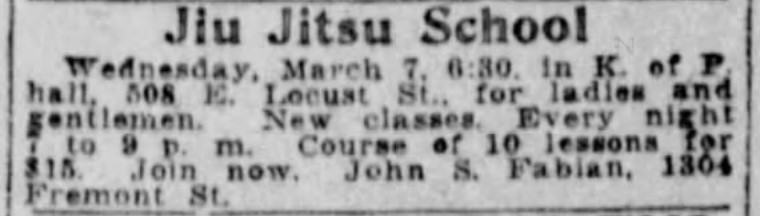
“Jiu Jitsu School.” Des Moines Register. Des Moines, Iowa: February 27, 1923, 13.

The advertisements I was able to locate to teach women jujitsu popped up in Iowa newspapers from 1900-1930s. Then didn’t show up again until the late 1960s. Was it due to the threat of Japanese imperialism? The return to domesticity of the 1950s? Maybe all of the above? I don’t know how many women took these classes. But there must have at least been a demand. Otherwise, why advertise?3

  1. Rouse, Wendy, and Beth Slutsky. “Empowering the Physical and Political Self: Women and the Practice of Self-Defense, 1890-1920.” Journal of the Gilded and Progressive Era 13, no. 4 (2014): 470–99. ↩︎
  2. “The Suffragettes Who Used Jiu-Jitsu To Literally Fight For Their Right To Vote,” All That’s Interesting. April 23, 2017. https://allthatsinteresting.com/jujutsu-suffragettes. ↩︎
  3. Senryuken, Noguchi. Jujutsu. (1913). Translated by Eric Shahan, 2020. Darrell Max Craig. Japanese Jiu-Jitsu. Rutland, Vermont: Tuttle Publishing, 1995. ↩︎
  4. “Jiu Jitsu School.” Des Moines Register. Des Moines, Iowa: February 27, 1923, 13.
    “Jiu Jitsu Club.” March 12, 1923. Des Moines Register. Des Moines, Iowa: 12.
    “Draws ‘Oofs’ Of Sheriffs By Jiu-Jitsu.” Des Moines Tribune. Des Moines, Iowa: December 12, 1935, # 17. “Jiu-Jitsu Expert to Teach Self-Defense.” Des Moines Register. Des Moines, Iowa: January 29, 1924, 3. “Masters of Self-Defense.” Iowa Bystander. Des Moines, Iowa: April 11, 1913, 2. ↩︎
Publishing

Hiring a Development Editor

Editing my current manuscript feels like a vicious, never-ending circle. I worked solo on the manuscript, honing structure guides like Story Grid or The Writer’s Journey. I used wonderful critique partners1 who provided insightful feedback. I even signed up for a first-chapter boot camp with Writer’s Digest. The agent assigned gave me examples of why they’d request more pages and why they wouldn’t. What struck me the most in the agent’s response was their reference to time. They didn’t have time to assist their clients with editing. They wanted a nearly finished product ready to sell. This was intriguing and frustrating.

In today’s market, the era of building relationships with editors like Max Perkins or Robert Gottlieb2 is over. Today’s writer is expected to either have the editing chops to cut their darlings or hire out.

I decided to hire an editor. But what kind did I need? I wasn’t even close to attacking the syntax stage aka a copy editor. I wanted a professional eye trained to look at my plot, character’s motivations, and pacing and tell me if my structure was working. Cue the development editor/book coach.

Where to look for a reputable development editor?

  • Google Searches
  • Reedsy

Eventually, I stumbled upon an article by Julie Artz, announcing the partnership of Author Accelerator and She Writes Press (a very reputable hybrid publisher).

Author Accelerator’s website was pretty straightforward. After completing a questionnaire and providing a sample piece, I was paired with Samantha Skal, a development editor and book coach.3

Sam provided me a road map for my manuscript. She pointed out where the manuscript had cracks, potholes, and craters. While asking me candid questions about my manuscript and where I wanted the story to go. Overall, she gave me a clear path on how to take my manuscript to the next level.

While the writing journey is mostly solitary, sometimes we must be willing to invite people along for the ride. Each passenger has different skill sets. But they all make the journey better and less lonely.

Gilmore Car Museum (2023)

Speaking of journey, this is a Cord 812 (1937). When I think of Pre-WWII cars this make and model is the first thing that pops into my head. Dubbed the “baby Duesenberg”, the Cord promised the same elegance and class as its expensive parent, only the Cord 810 & 812 had all kinds of electrical problems once it was out on the road.4

SOURCES:

  1. Guppies Chapter of Sisters in Crime * WFWA Critique Group Program, Historical Novel Critique Group (Closed FB Group) ↩︎
  2. Max Perkins was the editor for the likes of Thomas Wolfe, Ernest Hemingway, F. Scott Fitzgerald, and others. Gottlieb edited Joseph Heller, Toni Morrison, and others. Berg, A. Scott. “On Max Perkins, One of America’s Greatest Editors.” Lithub. 13 June 2016. Accessed: 9 November 2023. Gross, Terry. “Remembering Acclaimed Editor Robert Gottlieb.” NPR. 21 June 2023. Accessed: 09 November 2023. ↩︎
  3. Samantha Skal, Book Coach. Emma Dhesi. “How to Write Twists and Reveals in Your Suspense Novel with Samantha Skal.” Youtube. 28 March 2023. Accessed: 9 November 2023. ↩︎
  4. 1937 Cord Supercharged Beverly Sedan.” Gilmore Car Museum. 2023. Accessed: 9 November 2023. Butler, Don. Auburn, Cord, Duesenberg. Osceola, Wisconsin: Motorbooks International Publishers, 1992, p. 328. ↩︎
Iowa History

Iowa Roads (1937)

When writing my latest novel, the thing that struck me the most was the amount of time my characters spent in cars. The Middle West (using the 1930s term here) is so spread out. An automobile is a necessity. Then or now.

By the late 1920s, nearly 1 out of 3 people owned an automobile in Iowa.1 A bond initiative in the 1920s kept the expansion of paving roads a possibility throughout the Great Depression.2 Making getting from point A to point B that much easier (Safer is for a different post). However, building roads was one thing maintaining them was another. Many cash-strapped counties had difficulty keeping up with maintenance.3

With the increase of car traffic on Iowa roads, crime followed. Ola Babcock Miller, was Iowa’s first woman secretary of state, elected in 1932. One of her champion projects was pushing the legislature to pass a law creating an agency to monitor state road traffic. In 1935 the legislature formed the Iowa Highway Patrol.4

The numbers on the left represent the number of miles of roads in Iowa. Data taken from William Thompson’s Transportation in Iowa, p. 183.

Per a 1936 Iowa travel map5, there were a lot of U.S. and Iowa highways available in 1937. Here are a few I’m highlighting:

US Highways

  • Highway 6: Runs east and west and is considered the longest highway created in the U.S. It cuts through the south-central portion of Iowa. While it reached coast to coast in 1937, not all of it was paved.6
  • Highway 65: Runs north and south. Originally christened Jefferson Highway until the number system superseded the name in 1926. This road ran from Louisiana all the way to Minnesota. The road used a viaduct cutting over railroad lines located on 7th street in Des Moines, Iowa, before moving north out of town.7

State Highways

  • Iowa State Highway 7: Was decommissioned in 1939 and replaced with US Highway 32. In its infancy, the only section paved was at Johnston Station (now Johnston, Iowa) to Des Moines. By the end of the 1930s, it stretched east to west across the state.8
  • Iowa State Highway 60: Was decommissioned in 1969. It connected towns in north central Iowa with Des Moines.9
Back page of “Iowa Highway Map, 1936.” Ames, Iowa: Iowa State Highway Commission, 1936.

Sources:

  1. Peverills and the Automobile 1906-1952.” Amherst College Digital Collection. Accessed: 7 November 2023. ↩︎
  2. Thompson, William. Transportation in Iowa. Iowa: Iowa Department of Transportation, 1989, p. 155. ↩︎
  3. Ibid, p. 180. ↩︎
  4. Nebbe, Charity. “History of the Iowa State Patrol.” Iowa Public Radio. 23 July 2014. Accessed: 10 November 2023. Location: https://www.iowapublicradio.org/show/talk-of-iowa/2014-07-23/history-of-the-iowa-state-patrol. I would recommend a visit to the Iowa Gold Star Museum where one wing is devoted to the history of the Iowa State Patrol. ↩︎
  5. Iowa Highway Map, 1936.” Ames, Iowa: Iowa State Highway Commission, 1936. Accessed: 10 November 2023. The WPA Guide to Iowa is also a good source, especially their “Travel” chapters which highlight which paved roads to take for touring the state. ↩︎
  6. Historic U.S. Route 6.” Travel Iowa. 2023. Weingroff, Richard F. “U.S. 6 – The Grand Army of the Republic Highway.” Highway History, U.S. Department of Transportation, Federal Highway Commission. 27 June 2017. Accessed: 10 November 2023. ↩︎
  7. Henry, Jr., Lyell D. The Jefferson Highway. Iowa: University of Iowa Press, 2016, pp. 129-138. ↩︎
  8. Hancock, Jason. “Iowa Highways: 1 to 9.” Iowa Highways. 3 June 2023. Accessed: 10 November 2023. ↩︎
  9. Ibid.Iowa Highways: 60 to 69.” Iowa Highways. 3 June 2023. Accessed: 17 May 2021. ↩︎
Iowa History

Packard & the Modern Woman

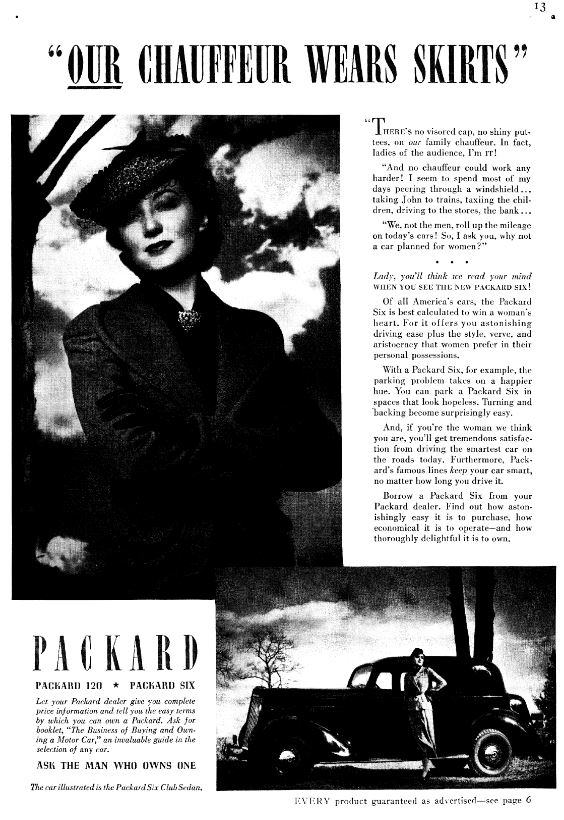
“Ask the Man Who Owns One” Packard Advertising 1937

The economy was looking a little better by the spring of 1937.1 The Packard Automobile Company decided to cash in on the prosperity. “From 1930 until World War II, Packard was the foremost luxury automobile, not only in America but internationally as well.”2 This time around Packard advertisers turned their attention to the female market. Especially with the introduction of lower-cost models such as the Six and One-Twenty.3

An upper-middle-class woman in the late 1930s needed a Packard for the following:

1) Shopping 2) ‘Jitneying’ aka dropping the kids off at school 3) A social life 4) Save money.4

The advertising ploy apparently worked. Packard saw an increase in production from 1936 (80,699) to 1937 (109,518). Due to the Crash of 1937, much of the previous years’ prosperity was lost (50,260).5

Des Moines, Iowa

Your Money May Never Go This Far Again.” Packard Advertisement. Des Moines Tribune. Des Moines, Iowa: 17 May 1937, 9.

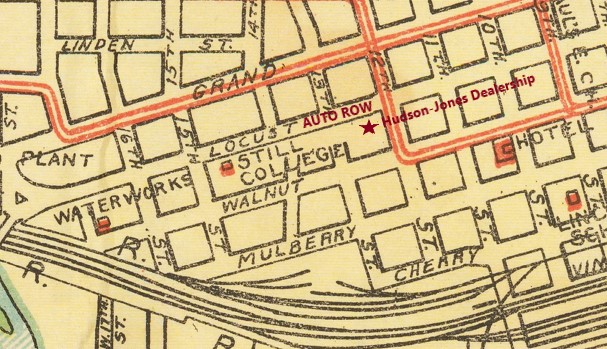
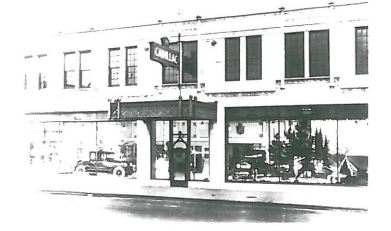
One of the lead Packard Dealers was Hudson-Jones Automobile Company, located at 1408 Locust Street. This area of Des Moines was known as “Auto Row” on the west side of downtown as early as 1916 until post-WWII when many of the auto dealers moved to the east side of the Des Moines River.6 One historian suggested the garages became too small to accommodate the length of the cars.7 The Hudson-Jones Dealership property was owned by the Hubbells who provided a long-term lease to the auto dealer. By the late 1920s, Hudson carried a wide range of cars. Later, it operated as a wholesale distributor to many rural towns in Iowa. For example, a dealer would bring his customer to Des Moines for purchase, and the dealer would then provide the ongoing maintenance. The building was expanded in 1933 and later demolished to make way for new construction in 2002.8

1408 Locust Avenue, 1925.

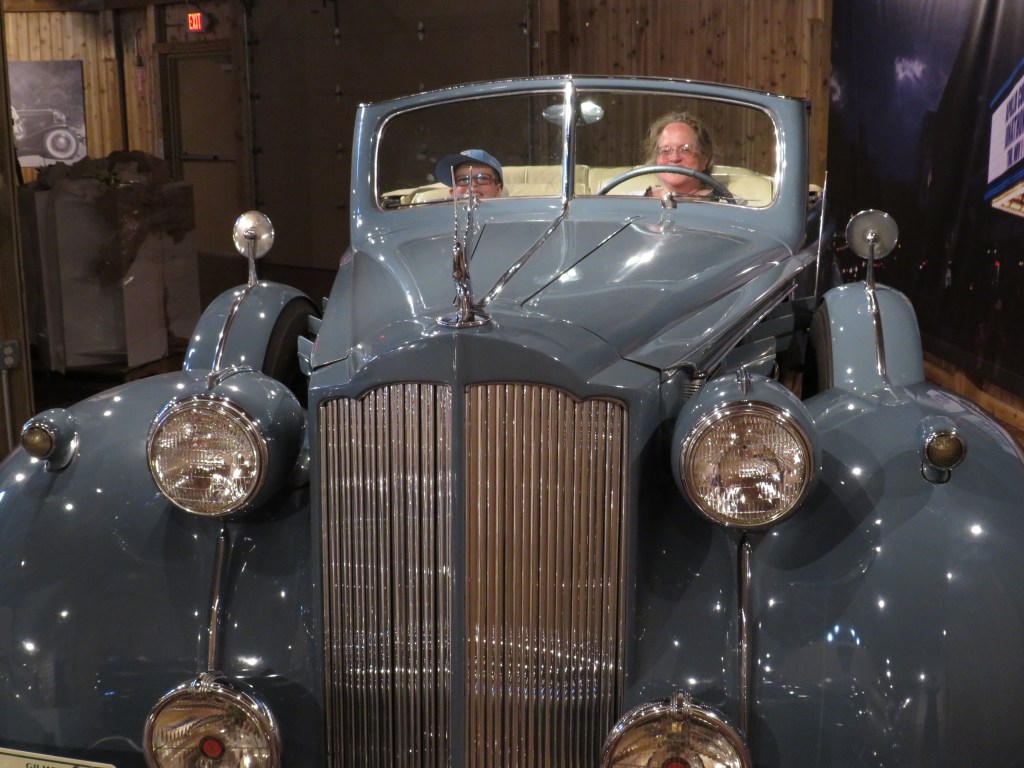
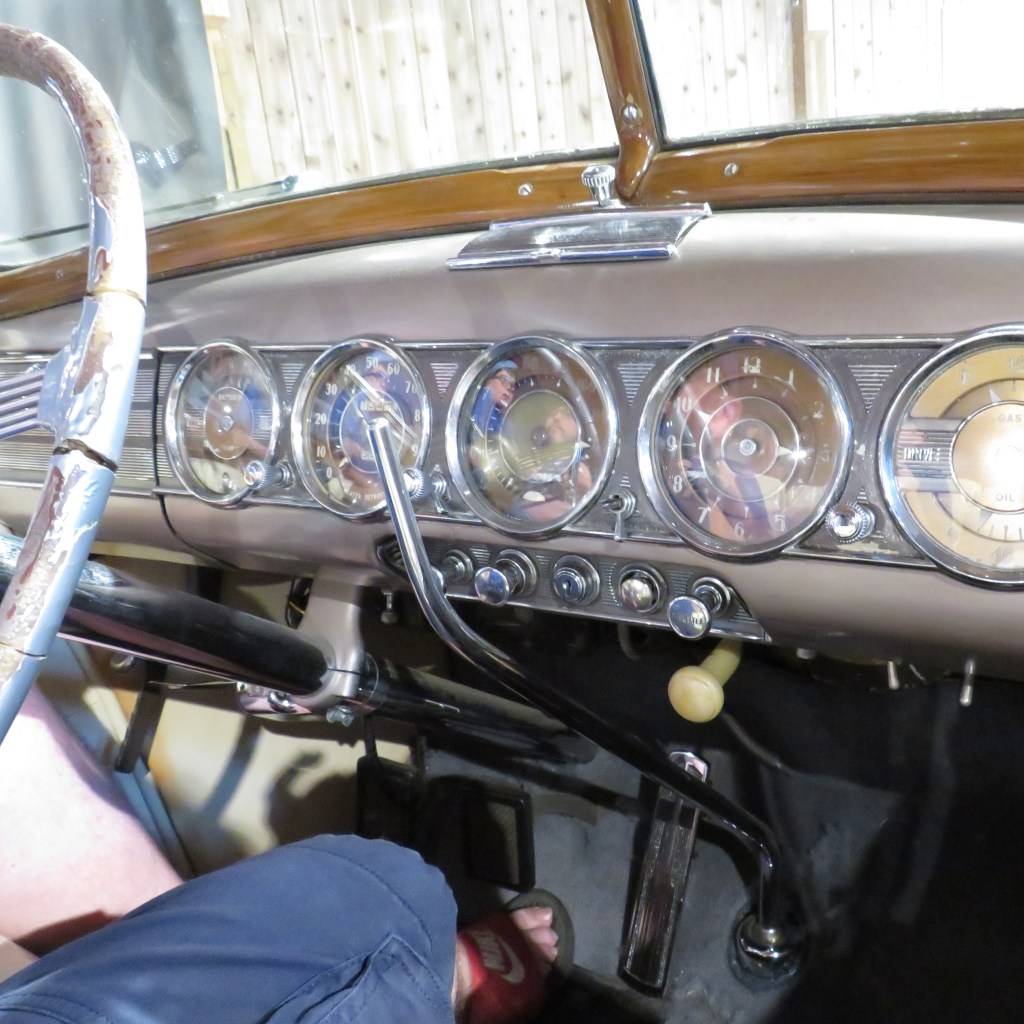
A Packard is my favorite pre-World War II car. I felt they had a refinement and elegance that a lot of cars of the era couldn’t match. I was fortunate enough to sit in one at the Gilmore Car Museum. I’m very short, but I was able to adjust the seat and sit comfortably (the giant steering wheel takes some getting used to).

Sources:

  1. Depression of 1937.” Digital History. 2021. Accessed: 6 November 2023. ↩︎
  2. Peverills and the Automobile 1906-1952.” Amherst College Digital Collection. Accessed: 7 November 2023. ↩︎
  3. Arthur W. Einstein. “Ask the Man Who Owns One”: An Illustrated History of Packard Advertising. New York: McFarland & Company, 2016. ↩︎
  4. Heitmann, John. “1937 Packard 120 — The Perfect Car for a Woman’s Personal Use.” The Automobile and American Life. 21 April 2018. Accessed: 6 November 2023. “Three Reasons Why Women Leave Home.” Good Housekeeping, 3. Volume 104 (March 1937): 13. Cornell University Library Digital Collections. Accessed: 6 November 2023. “Our Chauffeur Wears Skirts.” Good Housekeeping, 5. Volume 104. (May 1937): 13. Cornell University Library Digital Collections. Accessed: 6 November 2023. ↩︎
  5. Einstein. “Ask the Man Who Owns One”. Most women didn’t have access to available credit to purchase a car. And if they did they needed a male co-signer until the Equal Credit Opportunity Act was passed in 1974. Sandberg, Erica, and Claire Dickey. “The History of Women and Credit Cards.” Bankrate. 1 March 2023. Accessed: 23 November 7. ↩︎
  6. Jacobsen, James E. “D.S. Chamberlain Building.” National Register of Historic Places Registration Form. United States Department of the Interior, National Park Service. 13 March 2007. Accessed: 7 November 2023. ↩︎
  7. James, Jennifer. “G.W. Jones Building.” National Register of Historic Places Nomination Form. United States Department of Interior, National Park Service. 29 April 2016. Accessed: 7 November 2023. ↩︎
  8. Peverills and the Automobile 1906-1952.” Amherst College Digital Collection. Accessed: 7 November 2023. “The Des Moines Public Library building turns 15 with a look back at the past.” Des Moines Register. Online. 8 April 2021. “Hudson-Jones Leases Building.” Des Moines Tribune. Des Moines, Iowa: 16 June 1933, 17. ↩︎
Iowa History

King Ying Low (1937)

Director King Vidor (1894 – 1982) and actress Marion Davies (1897 – 1961) tuck into a takeaway meal during the filming of ‘The Patsy’ (aka ‘The Politic Flapper’) on Oct. 6, 1927
 John Kobal Foundation / Getty Images

History

Chinese food was one of the first ‘fast food’ alternatives in the early twentieth century. It was cheap, incredibly tasty, and wholly an American invention. In the 1920s people were flushed with extra cash. Chop suey houses were often open late to serve the partying crowd. Or patrons who desired a taste of something more exotic than what they served at home.1

Des Moines, Iowa

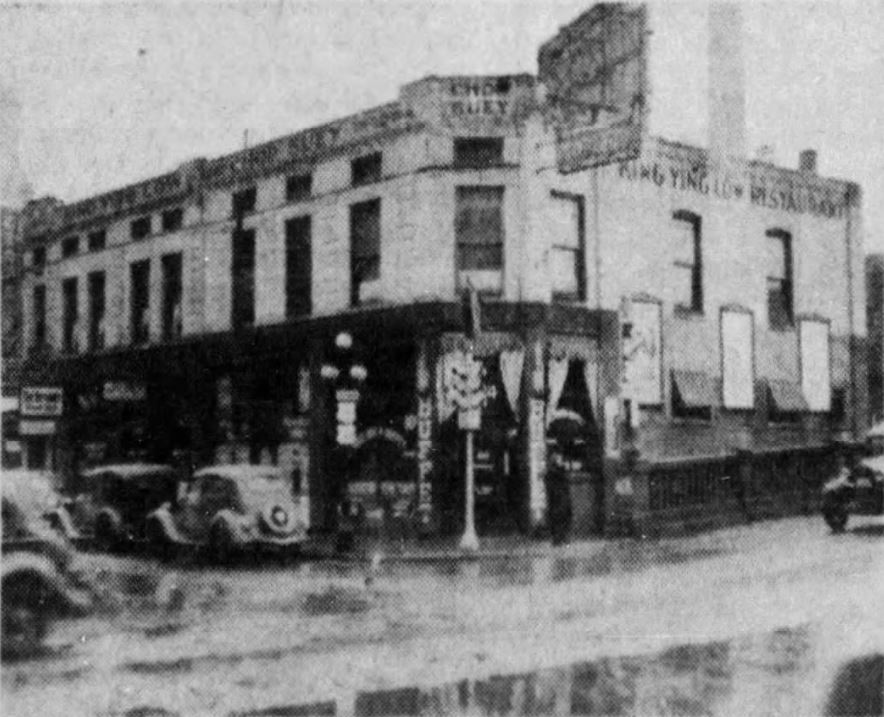
Considered by many to be Des Moines’ oldest Chinese restaurant, King Ying Low opened its doors on 5th and Locust Streets in 1902. After a stint in the Minnesota important business, Lee Dinn was persuaded to travel south because “Des Moines people are good with whom to deal.” The restaurant moved to its second location on the second floor of 618 Mulberry Street where the business remained until a reality company purchased the building and demolished it for a parking lot in 1940.2

King Ying Low. 618 Mulberry Street, Des Moines, Iowa, 1920. The Official Map and Guide of Des Moines. Des Moines, Iowa: Midland Map & Engineering, Co., 1920.

The stairs leading to the second floor of the Mulberry Street location were rickety and treacherous in the winter. When guests finally arrived on the second floor, they were greeted by waves of grease and fried food. Marble table tops offered chopsticks rather than silverware. Staff dressed in black trousers, white shirts, and black bow ties. If you couldn’t afford to venture up to the restaurant, they had their own delivery service which mixed everything and placed the food in narrow, paper boxes with cut-out folded tops.3

King Ying Low was located at 618 Mulberry Street in 1936 (“Razing Plans.” Des Moines Tribune. Des Moines, Iowa: 26 December 1936, 3).

Menu:

Steaks ($ .70 which is what people came in for), salads, ice cream, chop suey (hash style broth with bits of veggies and meat), chow mien, fish (cooked in a brown sauce), egg rolls, egg foo (Kid’s menu). Drinks – Tea or ‘no-mas-das” or rice liquor.4

Sources:

  1. Coe, Andrew. Chop Suey. New York: Oxford University Press, 2009. Keiles, Jamie Lauren. “The History of Jews, Chinese Food, and Christmas, Explained by a Rabbi.” Vox. 25 December 2020. Accessed: 26 February 2021. Lewis, Sinclair. Main Street. New York: Library of America, 1992. Liu, Haiming. From Canton Restaurant to Panda Express: A History of Chinese Food in the United States. New Brunswick, New Jersey: Rutgers University Press, 2015. Yong, Chen. Chop Suey, USA: The Story of Chinese Food in America. New York: Columbia University Press, 2014. Wouk, Herman. Marjorie Morningstar. Thorndike, Maine: G.K. Hall, 1996. ↩︎
  2. “King Ying Low, Des Moines’ Oldest Chop Suey, Passes Into New Hands — Lee Din Going Home.” Des Moines Tribune. Des Moines, Iowa: 08 April 1924, 1, 5. “King Ying Low Cafe to Move.” Des Moines Register. 04 August 1940, 42. ↩︎
  3. “About February 1.” Des Moines Tribune. Des Moines, Iowa: 26 December 1936, 3. “King Ying Low Restaurant Grand Opening Thursday.” Des Moines Tribune. 04 September 1940, 5. Rude, Emelyn. “The American History of Takeout and Delivery.Time. Online. 14 April 2016. Accessed: 11 June 2023. ↩︎
  4. “About February 1.” Des Moines Tribune. Des Moines, Iowa: 26 December 1936, 3. “King Ying Low Restaurant Grand Opening Thursday.” Des Moines Tribune. 04 September 1940, 5. ↩︎
Iowa History

Des Moines, Iowa (1937)

Dorothy Schwieder, a renowned historian, summed up late 1930s Iowa scholarship in one brief paragraph (while entire chapters of this book were devoted to 1929-1932 in extensive, exhaustive detail, but I digress…):

By 1937 economic conditions had improved for both rural and urban dwellers in Iowa. The Agricultural Adjustment Act, passed in 1933, had brought improved conditions for Iowa’s farm families. In 1932 national farm income had totaled $5.5 billion, and that amount had risen to nearly $8.7 billion in 1935. Though participation in the A.A.A. was voluntary, approximately 75% of Iowa farmers took part. Many Iowans talked in terms of the Depression coming to an end in 1938.1

Dorothy Schwieder. Iowa the Middle Land. Ames, Iowa: Iowa State University Press, 1996, p. 272.

If this is the extent of late 1930s Iowa scholarship, where does a writer of historical fiction go in search of sources?

WPA Guides:

History:

48 state guides were published. Each guide provided general state history and offered suggested tours through varying parts of the state.2

Iowa:

Originally published in 1938 as Iowa: A Guide to the Hawkeye State, this tome covers Iowa in detail. General history, cities, maps, and suggestive travel guides. There are places in Des Moines that were either glossed over or intentionally excluded (see Maps: redlining).3

Newspapers:

Des Moines Register:

Gardner Cowles, Sr purchased the Register and Leader in 1903. By 1915 newspaper’s name changed to The Des Moines Register. Cowles, Sr. pushed distribution via train and truck (Or any transportation necessary to get his newspapers into readers’ hands). This newspaper focused on world and state-wide issues. It was Des Moines’ morning newspaper.4

Des Moines Tribune:

This was Des Moines’ evening newspaper. While it was also owned by the Cowles family, the newspaper maintained its own staff and was often considered a rival of the Des Moines Register. This paper covered Des Moines and the surrounding towns exclusively.5 (5).

Bystander:

Was the state-wide Black newspaper. Originally published as the Iowa State Bystander in 1894. By 1937 the newspaper was known as The Bystander. It was owned by James B. Morris a lawyer and political leader.6

Maps:

Regular Map:

One of my favorite maps to reference is The Official Map and Guide of Des Moines. Des Moines, Iowa: Midland Map & Engineering, Co., 1920. It has wonderful details of parks, official buildings, and call-out locations. While this map is a decade earlier than my story (there are lots of places I know did not exist in 1920 but did in 1937), this map is still a great resource for getting a visual clue of Des Moines, Iowa.7

Redlining:

Midland Map & Engineering’s 1920 map tells only part of the story. Where people lived and why is another. The mortgage industry and the U.S. government developed redlining maps from 1934-1938. Government agencies used and strengthened local segregation practices by establishing a color-coded system to highlight reinvestment possibilities. Areas deemed unfit for investment (predominately non-white neighborhoods), were given a red status. One such redlining map may be found here.8

One of the joys and frustrations of historical fiction is the hunt for details. It can also be an excuse to avoid writing. There are a couple of rules I follow so I don’t fall into the research trap. (1) 1:2 Rule: One primary source for two secondary sources. (2) I stop digging when secondary sources cite books I’ve already read. The setting is an important fiction element and should be a character of its own. Its job should be to shape the character(s) and establish the rules of society. Will the characters follow society’s rules? Or break them? What are the consequences of doing either one? Maybe answering those questions is why I love reading and writing historical fiction.

My own personal map of Des Moines in 1937 is found here.

Sources:


  1. Schwieder, Dorothy. Iowa the Middle Land. Ames, Iowa: Iowa State University Press, 1996, p. 272. ↩︎
  2. Corrigan, Maureen. “‘Republic of Detours’ Revisits A Group of Quirky, Depression-Era Guides to the States.” NPR. 16 June 2021. Accessed: 03 August 2022; Elm, L.M. “Reviews.” L.M. Historical Novelist. 2022. Accessed: 00 August 2022; Elving, Ron. “In the 1930s, Works Program Spelled HOPE for Millions of Jobless Americans.” NPR. 4 April 2020. Accessed: 03 August 2022. ↩︎
  3. WPA Guide to 1930s Iowa. Ames, Iowa: Iowa State University Press, 1995, pp. 227-246, 389-390. ↩︎
  4. Friedricks, William B. Covering Iowa: The History of the Des Moines Register and Tribune Company, 1849-1985. Ames, Iowa: Iowa State University Press, 2000. ↩︎
  5. Ibid. ↩︎
  6. Cotten, Sally Steves. “The Iowa Bystander: A History of the First Twenty-Five Years.” Masters Thesis. Ames, Iowa: Iowa State University, 1983. Accessed: 03 August 2022; La Brie III, Henry G. “James B. Morris Sr. and the Iowa Bystander.” The Annals of Iowa, 42 (1974), 314-322. Accessed: 03 August 2022; 1894-1921 is available through an online subscription service; 1921-1972 is available on microfilm at The State of Iowa Historical Society archives in Des Moines & Iowa City. ↩︎
  7. The Official Map and Guide of Des Moines. Des Moines, Iowa: Midland Map & Engineering, Co., 1920. Accessed: 03 August 2022. ↩︎
  8. Johnson, Lauren and Kendly Larson. “Iowa’s Maps.” Redlining in DSM. 2022. Accessed: 03 August 2022. ↩︎