Iowa History, Research

Summer Nostalgia

I just wanted to know more about private swimming pools.

A lead character in my current WIP comes from a very wealthy family. He had an injury where swimming/exercise alleviates pain and lessens his dependence on prescribed opiates.

I put off researching swimming pools for a couple of reasons:

  1. I hadn’t yet reached the necessary point in my story,
  2. Ignorance (how they work/who had them/ect.; swimming, as a child, wasn’t my thing).

One of my go-to sites is a closed group on Facebook called “Lost Des Moines“. Pictures and stories are posted about Des Moines, Iowa, where nostalgia often supersedes fact. For the most part, I treat this site as I would Wikipedia. It’s a good starting point, but if I want better truths I look elsewhere.
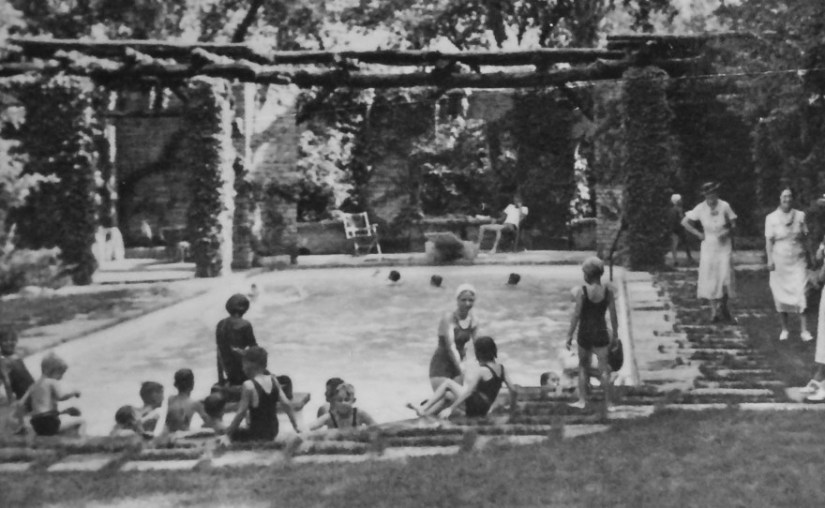
Terrace Hill Pool Party, 1937
“Pool Party at Terrace Hill, 1937.” Courtesy of John Pemble & Terrace Hill. “Terrace Hill Pool to Return.” Iowa Public Radio. 19 November 2015. Accessed: 08 August 2020.

“Lost Des Moines” posts regarding public pools were from adults who grew up in the 1950s and 1960s. Private pools, like anywhere else in the United States, were reserved for the wealthy. I was able to find swimming pools belonging to The Hubbells and Ding Darling (across from the Hubbell mansion, Terrace Hill, now home to the Governor of Iowa). Pool houses and how the swimming pools worked, I found in books centering on the wealthy elite from New York or Los Angeles. Technically, I found what I’d set out to find: the what, how, and why of private swimming pools. But in the back of my mind, I knew I wasn’t done. An NPR story and Clare Foran’s CNN article on Senator Tom Cotton solidified for me just why my research wasn’t complete.

The insidiousness of sites such as “Lost Des Moines” is nostalgia erodes the sharper points of history. The troupe of “things were better back then” may be true for one person, but not another. While Des Moines was often touted as an “open town” in the 1920s-1940s, well intentions often bucked reality.

When Marguerite E. Cothorn took her son swimming in the 1940s, she was often harassed or made to feel uncomfortable for allowing her son to play in Birdland Pool. Her harassers wanted to know why she wouldn’t take her son to Good Pool.
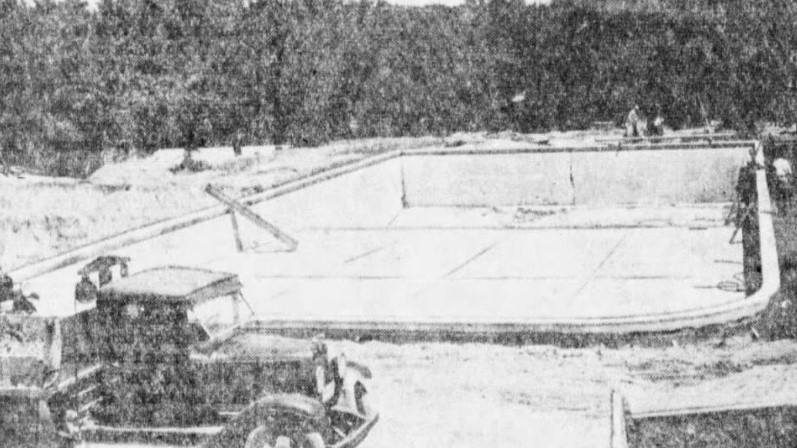
Good Park
“New Swimming Pool in Good Park, The.” Des Moines Register. Des Moines, Iowa: 25 June 1936, 13. www.newspapers.com Accessed: 21 July 2020.

Good Park has University Avenue on the north and Keosauqua Way on the east. The park and pool were also located near Center Street, a segregated African American business district (destroyed under the guise of urban renewal and McVicar/235 Hwy). Good Pool was a WPA project completed in 1936. The upkeep of the pool amounted to $3,000 a year for the city. The Des Moines Register and city ofificals perpetuated racism in several ways. While articles never specifically stated it was a segregated pool, they did a make a point to state, “There will be a Negro lifeguard at the pool.”  Or when other pools in Des Moines had to list the prices for admission ($ .25 for adults; $ .15 children), Good Pool’s cost would “probably be lower than at the other two pools”.

Misogyny plays a far bigger role in my current work than racism (single woman/P.I. 1937–you get the picture). However, when I am confronted with the uncomfortable realities of the past, unlike the Senator from Arkansas, I make a conscious effort to try and educate myself. And I still have a long way to go.

Sources:

“13 Acres Along River Wants City to Buy a Park Purchase Price is Set at $2,200.” Des Moines Register. Des Moines, Iowa: 29 May 1937, 3. www.newspapers.com Accessed: 21 July 2020.

“City Swimming Pools Open June  1.” Des Moines Register. Des Moines, Iowa, 13 April, 1937, 3. www.newspapers.com Accessed: 21 July 2020.

Cothorn, Marguerite E. “Civil Rights and Black History of Iowa.” Audiocassette. Vol. 72. 2 vols. Iowa Oral History Project. Des Moines, Iowa, 1986.

David, John. “Stalking Des Moines with my Camera.” Lost Des Moines. Facebook. Accessed: 22 Juy 2020.

Foran, Clare. “G.O.P. Senator Tom Cotton Pitches Bill to Prohibit Use of Federal Funds to Teach 1619 Project.” CNN Online.  24 July 2020. Accessed: 24 July 2020.

Gary, Thomas A. “The Rise and Fall of Center Street: 1945-1972.” Masters, Iowa State University, 2003.

Gillespie, Bob N Betsie. “Terrace Hill.” Lost Des Moines. Facebook. 9 July, 2017. Accessed: 22 July 2020.

Jabbar, Akil. “Terrace Hill Pool.” Lost Des Moines. Facebook. 14 April 2015. Accessed: 22 July 2020.

Leeuwen, Thomas A.P. van. The Intimate History of the Swimming Pool. Cambridge, Massachusetts: MIT, 1999.

“New Swimming Pool in Good Park, The.” Des Moines Register. Des Moines, Iowa: 25 June 1936, 1, 13. www.newspapers.com Accessed: 21 July 2020.

Terrace Hill Pool to Return.” Iowa Public Radio. 19 November 2015. Accessed: 08 August 2020.

Wiltse, Jeff. Contested Waters: A Social History of Swimming Pools in America. Chapel Hill, North Carolina: University of North Carolina Press, 2010.

Iowa History, Research

Speakeasy in Des Moines

Two years after statehood, the Iowa legislature attempted unsuccessfully to pass its first prohibition law. They finally succeeded in 1916. Up until the federal government enforcement four years later, sheriffs and local agencies did the enforcement. Prohibition worked but wasn’t popular. While federal prohibition ended in 1933, many states continued to have some

In January a tour of an old speakeasy became available through the Des Moines Historical Society.

From the outside, the 1920s bungalow didn’t appear to have secrets, but there were clues if one looked close enough. The rocked arched way could have clued patrons to the basement stairway. Inside patrons could have enjoyed all kinds of booze. A huge boiler remains. There was speculation by the owner that it may have been used to distill alcohol. Elaborate designs on the woodwork and peepholes added to the general mystery. If only these walls could talk I’m certain they would have a lot to say!

Sources:

Bauer, Bryce. Gentlemen Bootleggers: The True Story of Templeton Rye, Prohibition, and a Small Town in Cahoots. Chicago, Illinois: Chicago Review Press, 2014.

Okrent, Daniel. Last Call: The Rise and Fall of Prohibition. New York: Scribner, 2010.

Porter, Sierra A. “Shhh! Des Moines Woman Discovers Hidden Speakeasy.” Des Moines Register. Des Moines, Iowa: 05 January 2020, p. 1E, 3E.

Iowa History, Research

Booze and Writing

The Thin Man by Dashiell Hammitt is one of my all-time favorite novels. It’s relatively short, hits all the marks for what a mystery should be, and the dialogue is just plain awesome. I adore the sexually charged banter between Nick and Nora Charles (and they’re actually a married couple!).  Re-reading it again recently I was also struck by the exceedingly high levels of their alcohol consumption.

My current novel takes place in Des Moines, Iowa in 1937, where Hammitt placed his characters in 1934 New York. After Volstead was repealed each state was left to determine how much alcohol they’d allow their citizens to consume.

Iowa has a long history of tried and failed attempts at prohibition. They were one of a handful of states that went dry prior to the Federal government demanded it with the passage of the Volstead Act. When prohibition was repealed in 1933, the Iowa legislature passed the Iowa Liquor Control Act the following year, giving the state a monopoly over the wholesale and distribution of all alcohol except beer.

Liquor by the drink was banned in restaurants and taverns (beer had to be > 3.2% alcohol content). However, an individual could still buy liquor by the drink. They applied for a liquor logbook which they were required to take with them when they made their purchases at the state-run liquor store. These stores were often in run-down and out of the way places. Browsing was not allowed. An individual filled out a form and the liquor store clerk pulled the bottles off the shelves. From the 1930s to the 1950s punch cards were used. The store clerk had sole discretion on what and how much they sold to an individual. If you had more punches then they thought reasonable they had the right to deny the sale. By the 1950s the punch cards were replaced with logbooks.

Many businesses flouted the rules to meet the needs of their customers. Illegal “key” clubs were the direct results. The business kept a row of lockers where individuals would store their liquor. An individual would give the waiter their key and the restaurant would supply the set up (glasses and ice). The legislature in the early 1950s made key clubs legal, but selling booze directly to restaurants was not. It wasn’t until the 1960s when a charismatic politician decided to change the law that Iowa’s liquor by the drink controversy would meet its end.

Harold Hughes was a WWII vet, former alcoholic, truck, driver, and, astute politician. He made it a part of his platform as governor to change the law. He said:

Let’s face it. You know and I know and every honest person in Iowa knows that we have liquor-by-the-drink in this state now…The moral issue, then is: Shall we straight-forwardly legalize the sale of liquor-by-the-drink, enforce the law and really control the liquor traffic in this state? Or shall we perpetuate the present wide-open club system that subsidizes the bootleggers and racketeers with revenue that rightfully belongs to the taxpayers of Iowa?

In January 1963 Hughes wielded his powers of the executive branch and began a system-wide crackdown on businesses, taverns, and even places like the VFW. Public pressure pushed the Iowa legislature to act and by July 4, 1963, liquor-by-the-drink was legal. The legislature, however, continues to hold a monopoly on the distribution of all liquor (except wine and beer) in the state.

Sources: