Trouble in Mind
It would be impossible for me to cite every document I consulted while creating Trouble in Mind. The sources listed below serve as a starting point for your own exploration of Evelyn Copeland’s world.
Cars
Cars of the era were meant to get you from point A to point B. Arriving at your destination safely was a bonus. Today’s automobiles are designed to take the brunt of the force and not the occupants.1
Cars had a clear hierarchy in the 1930s. Nash, built in the Midwest, offered solid, mid-priced vehicles for middle-class drivers. But if you wanted to announce you’d made it, you bought a car starting with “P”: Packard, Peerless, or Pierce-Arrow—the holy trinity of American luxury motoring.2
Auburn
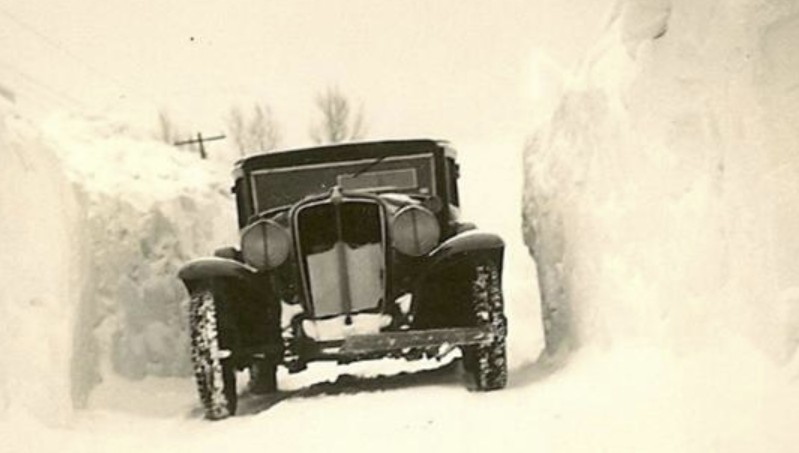
[1931 Auburn 8‑98 or 8‑98A taken from “Pieces of History: The Brutal Winter of 1936,” The Gazette, Online edition (Cedar Rapids, Iowa), December 30, 2019, accessed: December 10, 2023.]
Auburn produced the most affordable V-12 car in America, offering high-end performance at rock-bottom prices. But even this bold strategy couldn’t save the company from financial ruin. The Cord Corporation, which owned Auburn, declared bankruptcy in 1937.3
Cord
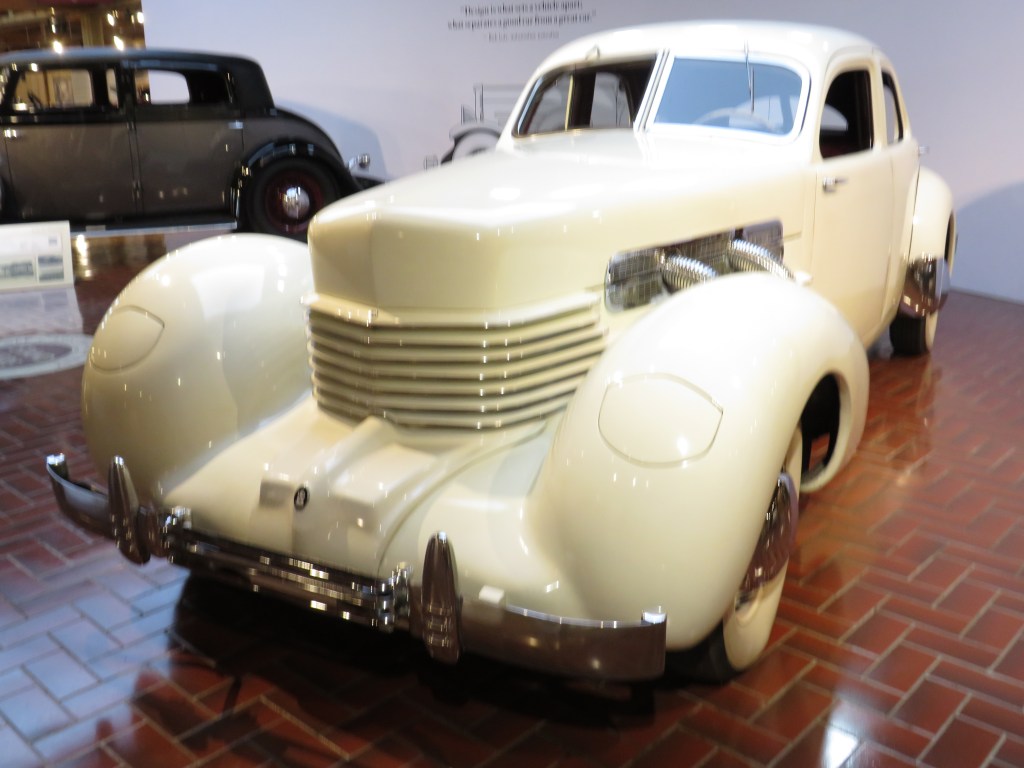
[1937 Cord Supercharged Beverly Sedan, Photograph, Gilmore Car Museum, 2023. Lisa Taber Collection.]
The Cord 810 and 812 were among the most famous cars of the 1930s, instantly recognizable for their coffin-nose design, hidden headlights, and pioneering front-wheel drive. Marketed as a “baby Duesenberg,” the Cord dazzled with style but struggled with mechanical reliability. Though Cord hoped to resolve issues after launch, only about 3,000 units were produced before the company shuttered in 1937.4
Franklin
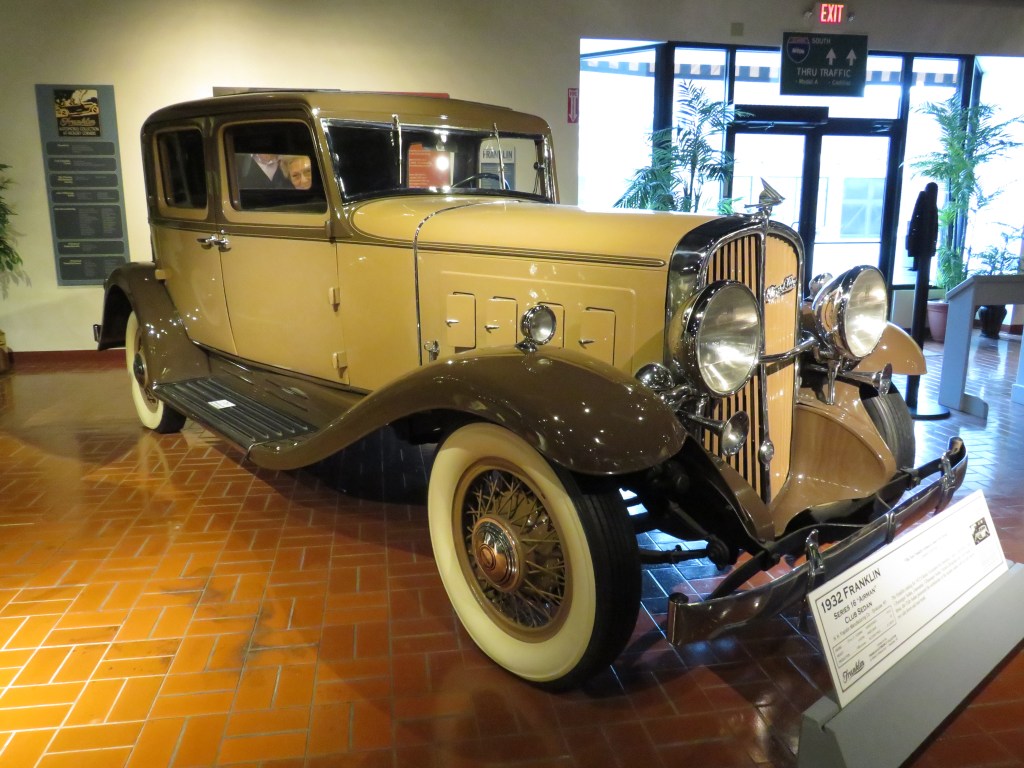
[1932 Franklin Series 16 “Airman” Club Sedan, Photograph, Gilmore Car Museum, 2023. Lisa Taber Collection.]
Was considered the “banker’s car”—conservatively styled but technologically advanced under the hood. Known for its air-cooled engines and lightweight aluminum construction, Franklin appealed to professionals who valued reliability. The Great Depression hit the company hard, and one of its last-ditch efforts was the Olympic, a REO Flying Cloud chassis fitted with a Franklin air-cooled engine. Only about 300 Olympics were produced before Franklin shuttered its doors in 1934.5
Ford
The Ford Tudor, made between 1927-1931, was not one of the more flasher Model styles. However, it still was a step up from the Model T.6
LaSalle
A semi-luxury automobile produced by Cadillac, a division of General Motors. By the late 1930s, it offered Cadillac styling and V-8 performance at a more affordable price, making it a smart financial choice for status-conscious buyers. Yet LaSalle struggled in the tight market created by the Great Depression, and General Motors ceased production after the 1941 model year.7
Oldsmobile
Oldsmobile was among the oldest American car manufacturers by the 1930s, having been founded in 1897. It weathered the Great Depression more effectively than many competitors by offering innovative design and engineering at an accessible price point.8
Packard
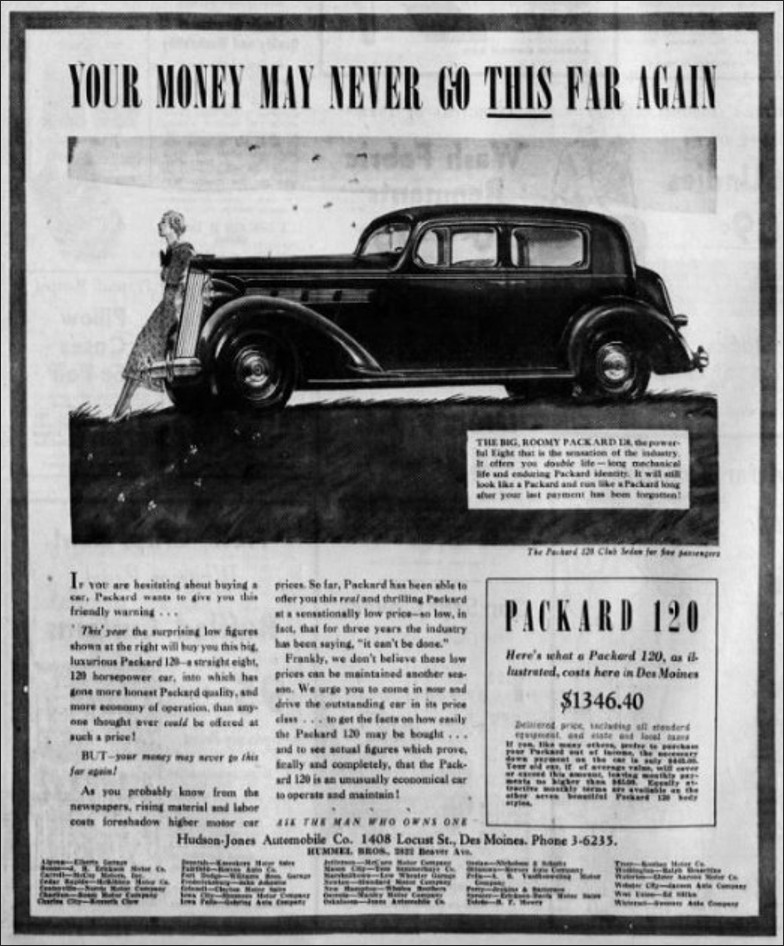
[“Your Money May Never Go This Far Again,” Packard Advertisement, Des Moines Tribune (Des Moines, Iowa), 17 May 1937, 9.]
The Packard Twelve Series was one of the last truly elite American automobiles. Priced at several thousand dollars during the Great Depression, it cost up to four times the average person’s mortgage. Most Americans could only admire it from afar, as it remained the domain of the ultra-wealthy. Packard Auto Company offered cheaper models in the hopes of staying in the black. For some, this tarnished Packard’s elite image. This decision helped keep Packard in business until the 1950s.9
Pierce-Arrow
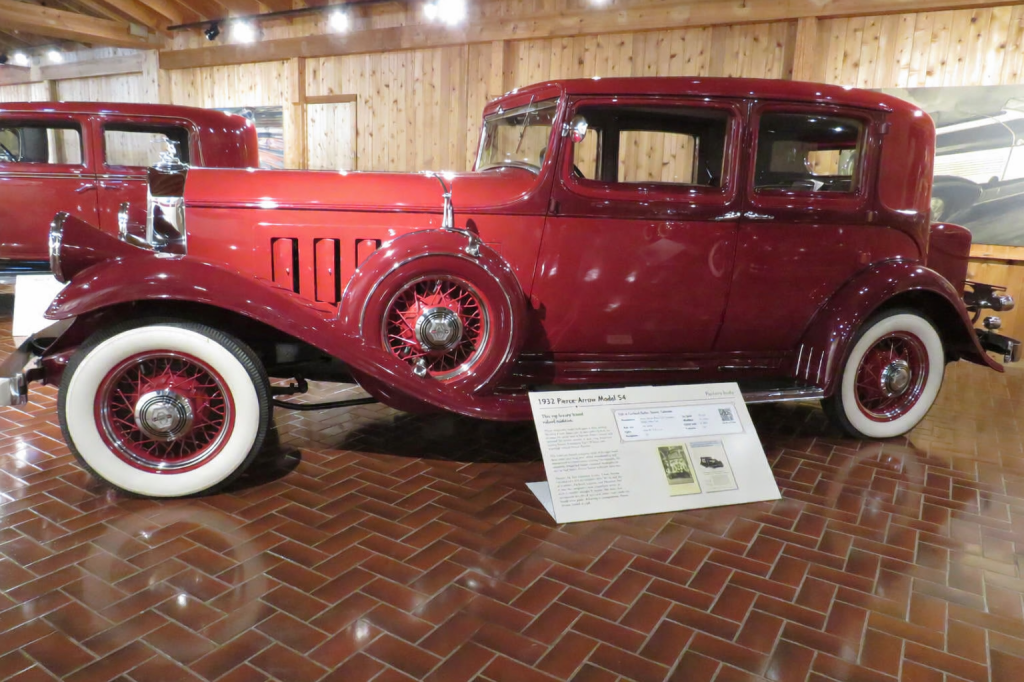
[1932 Pierce-Arrow Model 54, Photograph, Gilmore Car Museum, 2023. Lisa Taber Collection.]
Pierce-Arrows were among the leading luxury cars of the 1930s—large, expensive, and favored by the elite. Known for their refined styling and engineering, they resisted producing cheaper models even as the Depression eroded the luxury market. Though a series of ownership changes offered temporary stability, the company ultimately struggled to remain solvent and ceased production in 1938.10
Era (1930s)
Economy
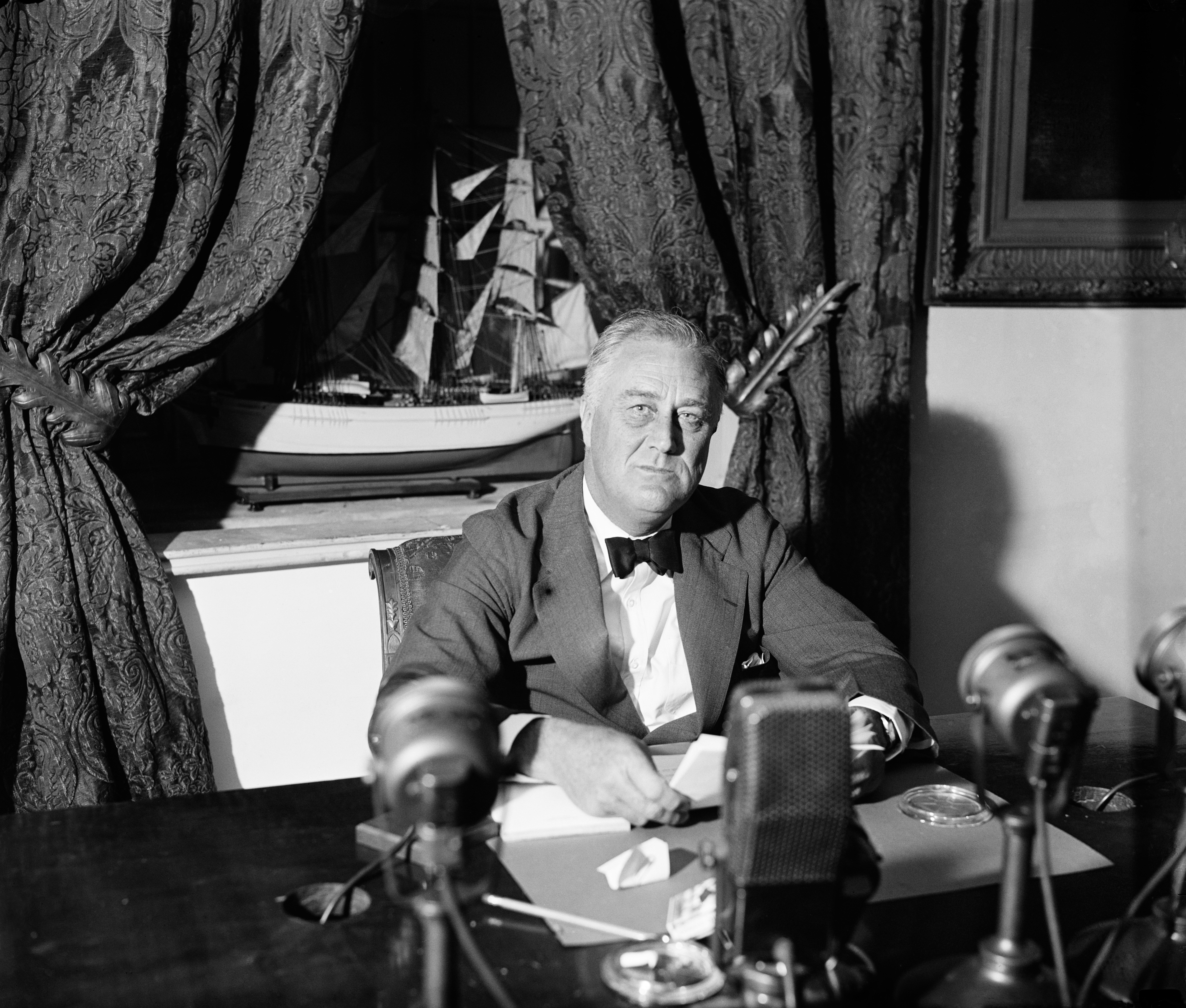
“FDR and the Great Depression (article) | Khan Academy,” Franklin D Roosevelt Great Depression, 2025, accessed April 05, 2026.
The recession in late spring of 1937, nicknamed “Roosevelt’s Depression” would put a wrench in all the gains previously made.11
Fashion
1930s fashion was shaped by practicality, modesty, and a quiet elegance—women dressed to endure the cold, honor social norms, and express personal style within economic constraints.12
Food

[“History of Waldorf Salad,” Quaint Cooking, November 14, 2019, accessed November 20, 2022.]
The Waldorf Salad debuted in 1896 at New York’s Waldorf-Astoria Hotel, created by maître d’hôtel Oscar Tschirky. Originally made with chopped apples, celery, and mayonnaise atop a bed of lettuce, the recipe evolved over time. By the 1920s, walnuts had become a popular addition, giving the salad its now-classic crunch and richness.13
I tried to find period kosher food for the scenes in this story.14
Literature
Tinkerbell was Peter Pan’s fairy companion in J. M. Barrie’s play and novelization. Ira would have been twenty when the novel was published (he’d have had his thumb on the pulse of children’s literature, being the trustee of a summer camp). I had a lot of cut scenes explaining how Ira’s childhood fairy obsession had manifested in adulthood. Eventually, I decided the best explanation he gives for it belonged in their negotiation at the Moonlight Tavern. I didn’t add the foreshadowing of Tinkerbell’s actions and how they related to Evelyn’s sacrifice until I was farther along in the story.15
Sex
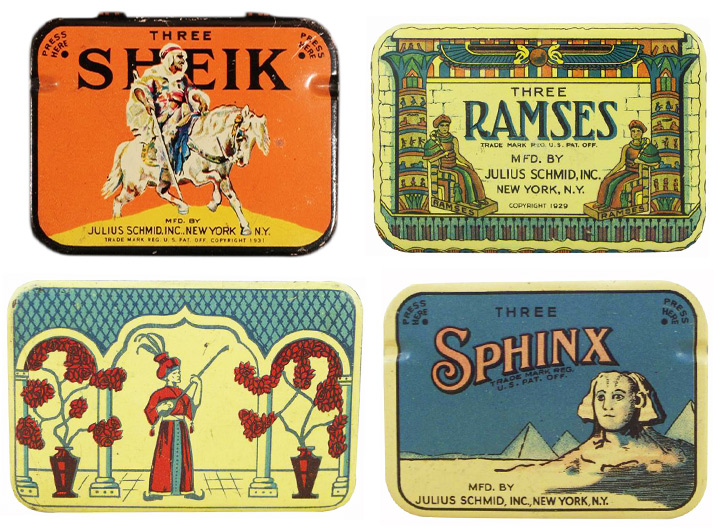
[Hunter Oatman-Stanford, “Getting It On: The Covert History of the American Condom,” Collectors Weekly, August 2012, accessed September 24, 2025.]
Human beings have sought to prevent pregnancy since ancient times. By the 1930s, prophylactics became more mainstream in the United States, aided by improved manufacturing and shifting public attitudes. Federal regulation began to evolve, particularly after a 1936 court ruling allowed physicians to legally distribute contraceptives.16
Ira’s sex box was loosely based on a similar piece in the Science Museum in the U.K.17

[H.G. Peter, Woman Comic, c 1945. “My Wonder Women,” CineGong, April 18, 2018, accessed December 21, 2019.]
William Marston explored his bondage fantasies in the Wonder Woman Comics.18
Sports
Boxing was one of the top sports in the United States during the 1930s. There was even local talent who were paid to fight. Pinkie George was a real promoter who booked fighters all over the Midwest.19
The famous heavyweight boxer, Max Baer, leaned into his Jewish heritage in the boxing ring. He was the World Heavyweight Champion from 1934-1935. Sixto Escobar was a bantam weight. Their weight classes were vastly different.20
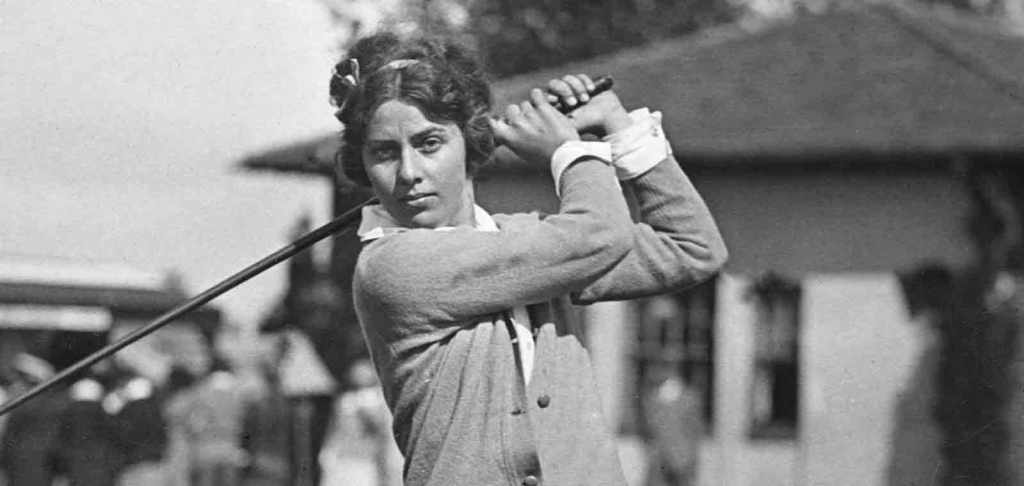
[Kikue Higuchi, “Reluctant Legend Glenna Collett-Vare Remains Vivid in LPGA Memory,” LPGA, November 14, 2022, accessed April 5, 2026.]
Glenna Collett Vare, born in 1903, perfected her game on the golf courses of New England. By the 1920s, she was formidable off the tee and was known as the “female Bobby Jones.” She later wrote several instructional pieces geared toward women and golf.21
Summer Camps
Summer camps were popular during the early twentieth century during the ‘physical culture’ movement. Getting people active, especially allowing city children to view the outdoors was a way to keep children occupied for the summers.22
Evelyn’s Kit Bag
Alcohol
The Iowa legislature passed the Liquor Control Act in 1934. This made public consumption of hard alcohol illegal. If you wanted it for home consumption you could purchase it at the state-run liquor store.23 Beer consumption was legal on or off the premises. Taverns, bars, and juke joints popped all over Des Moines to service thirsty customers.24 In the mid to late 1930s depending how who was in charge at city hall, nightclubs were raided for selling illegal hard liquor to patrons. Elizabeth Clarkson Zwart in her “Front Row” column in the Des Moines Tribune, often sited the happenings of the city’s nightlife.25
Divorce
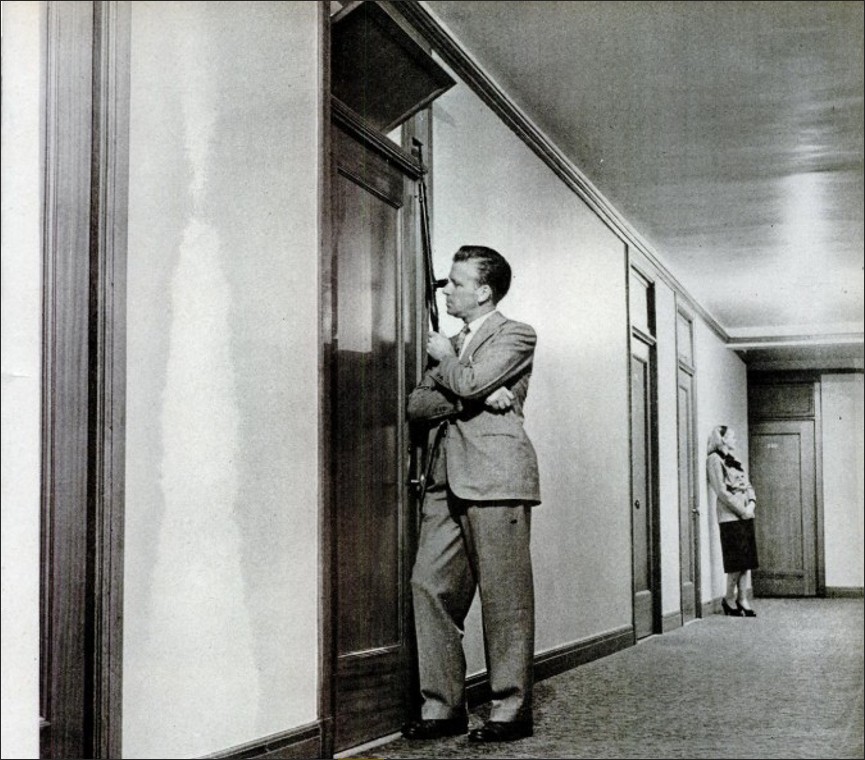
[Graham Moulton, “I Spy,” Life, September 22, 1947, 65-68;]
No-fault divorce didn’t exist in 1930s Iowa. Adultery was one of the few acceptable grounds—but it had to be proven, often with the help of a private investigator. My muse for the opening scene: a Life magazine photograph of a detective peering through a transom with a periscope while his assistant kept watch.26
Ju Juitsu
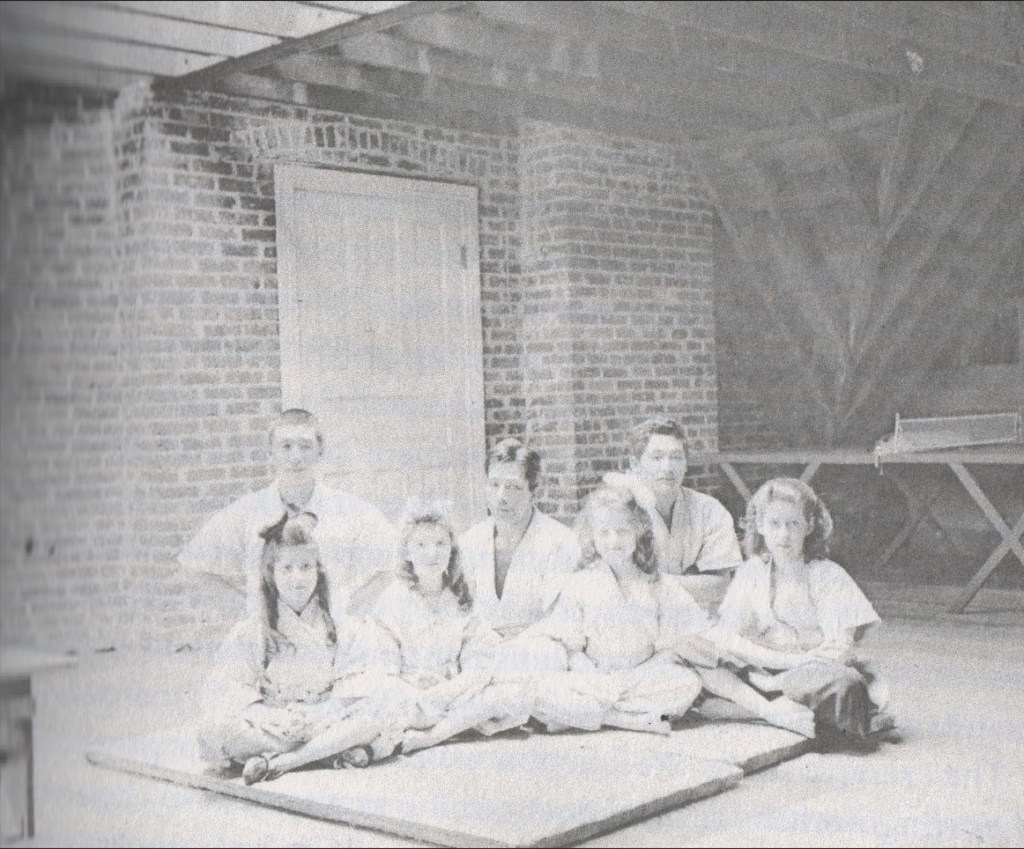
[Children’s class: Margaret Perrin — Miss A. Lee, ca. 1904. Yoshiaki Yamashita Photograph Album (PH 006). Special Collections and University Archives, University of Massachusetts Amherst Libraries]
The early twentieth century saw the rise of physical culture, especially among women. The prevailing belief was that caring for one’s body made a woman a better wife and mother. Jujitsu classes emerged as part of this movement and later became tools of resistance—used by suffragettes to defend themselves against police brutality during their fight for the vote. What exactly was taught in ju juitsu classes depended on the instructor. I mined period books for moves Evelyn might have used.27
In the Office
Carbon paper has been around since the early 19th century. But it didn’t come into modern use until the modernization of the typewriter. Carbon paper worked better with steady, consistent pressure.28
Crime scene investigation in the 1930s wasn’t standardized. I used a combination of new and old sources.29
Photography
Early twentieth century saw a photography boom especially with Kodak’s Brownie. A small light weight camera that was easy to use. Photos could be developed yourself or sent away for processing. High end cameras often came from German like the Leica.30
Swearing
[Watchwinder, “My Man Godfrey Outtakes and Bloopers,” Youtube, January 2, 2008, accessed March 01, 2024.]
Did people swear in the 1930s? Yes. And yes. Newspapers, novels, and especially the movies were censored. Music was often the place to go to find profanity and slang. Also, read any biography about Carol Lombard.31
Watches
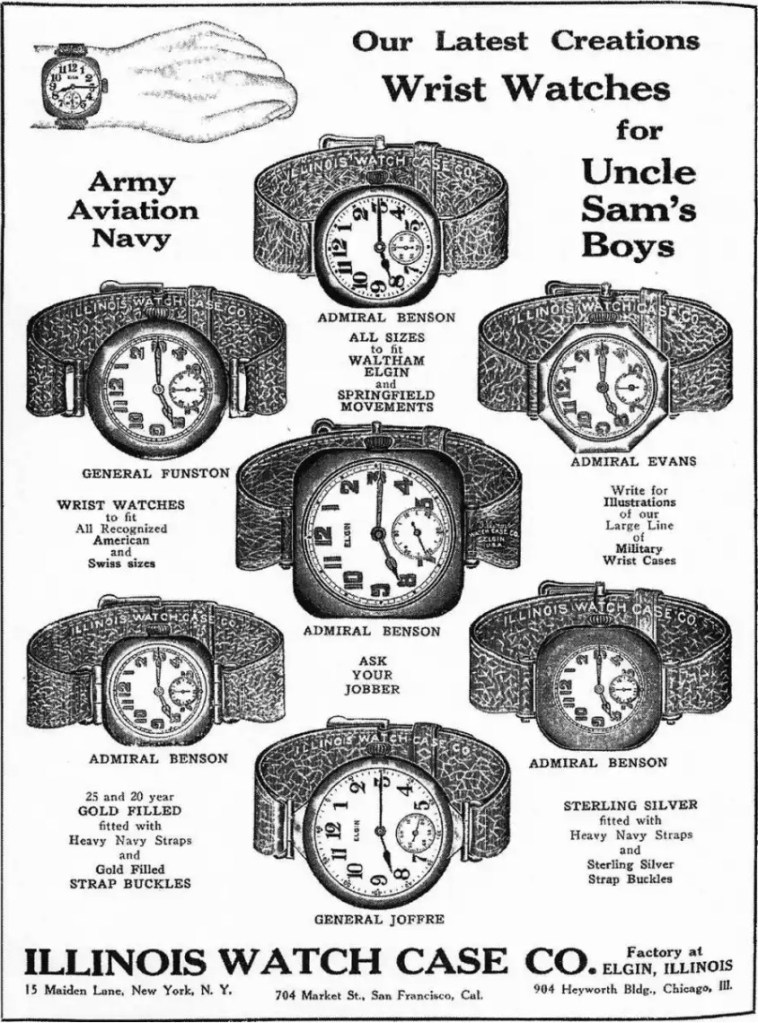
[“The History and Romance of World War I Trench Watches,” Antique Sage, June 8, 2020, accessed April 5, 2026.]
Pocket watches were still en vogue even though wrist watches were slowly replacing them. I made Evelyn have a trench watch because she would need an accessory that could take a beating in her line of work. I envisioned her purchasing one at a pawn shop while on a case. I had an edited scene where Ira calls her watch ugly and Evelyn counters its more functional and more durable than most men.32
Hollywood
Actors & Actresses
Gary Cooper was the Great Depression’s symbol of the handsome everyman. He chose roles that portrayed him as rugged, moral, and stoic.33

[“Jimmy Durante,” Britannica, February 6, 2026, accessed April 5, 2026.]
Jimmy Durante was a stage performer who migrated to Hollywood. He was know for comedy. His claim to fame was his big nose and catch phrase. He did a bunch of short sketches for Paramount in the 1930s.34
[Rotten Tomatoes Classic Trailers, “San Francisco Official Trailer #1 – Clark Gable Movie (1936) HD,” Youtube video, October 5, 2012.]
Clark Gable was the “it” fellow of Hollywood in the 1930s. He loved fast cars. Packards were one of his favorites. He owned a 1932 Packard Twin Six, 905 Roadster. Gable stared with Jeanette MacDonald in San Francisco. It played at the Des Moines and Roosevelt theaters in July 1936.35
[Racconti della Vecchia Hollywood, “Carole Lombard and George Raft, Bolero, 1934,” YouTube video, August 14, 2022, accessed March 17, 2024.]
Carol Lombard is one of my favorite actresses. She was labeled the “Profane Angel” because she used profanity as a weapon putting Hollywood men in their place. She starred with George Raft in the movie Bolero (1934).36
[Rotten Tomatoes Classic Trailers, “After the Thin Man Official Trailer #1 – James Stewart Movie (1936) HD,” Youtube video, October 5, 2012.]
Myrna Loy originally played exotic vamps but by the 1930s she often portrayed wives who outranked their husbands in style and wit.37
[42328, “Shirley Temple Poor Little Rich Girl Trailer 1936 with Alternate Takes,” Youtubevideo, Dec 1, 2021, accessed April 5, 2026.]
Shirley Temple’s string of hits saved Warner Brothers from bankruptcy.38
[Classicos do Cinema, “Trailer – The Crusades -as Crusades – 1935 Full HD,” Youtube, April 2023, accessed: April 28, 2024.]
Loretta Young was a celebrated film and television actress, known for her expressive eyes and refined beauty. Though she occasionally appeared with lighter hair early in her career, she embraced her natural brunette look by the 1930s, aligning with her transition into more dramatic and mature roles.39
Magazines
Modern Screen was another Hollywood Magazine in the 1930s.40
Photoplay began in 1911 and provided editorials, commentary, and photographs in the Golden Age of Hollywood. 41
Movies & Theaters
Movies
[Saturday’s Word, “1936 The Plainsman – Trailer – Gary Cooper, Jean Arthur,” Youtube video, July 21, 2018, accessed April 5, 2026.]
The Plainsman starred Gary Cooper as Wild Bill Hickok and Jean Arthur as Calamity Jane with renowned director Cecil B. DeMille at the helm. The original release date was November 16, 1936. Des Moines didn’t get the movie until the week of February 19. I tweeted the date for this scene.42
[Rotten Tomatoes Classic Trailers, “Tarzan Escapes Official Trailer #1 – E.E. Clive Movie (1936) HD,” Youtube video, Oct 5, 2012, accessed April 5, 2026.]
Tarzan Escapes was the first Tarzan movie produced postproduction code. Jane’s character played by Maureen O’Sullivan was stripped of her sexuality and given more clothes to wear. Tarzan’s loin cloth didn’t suffer the same treatment. The movie was shown at The Paramount in December 1936. It was gone from Des Moines by January 1937. But continued to play at rural Iowa theaters in January and February 1937. But I altered it for the story.43
Theaters
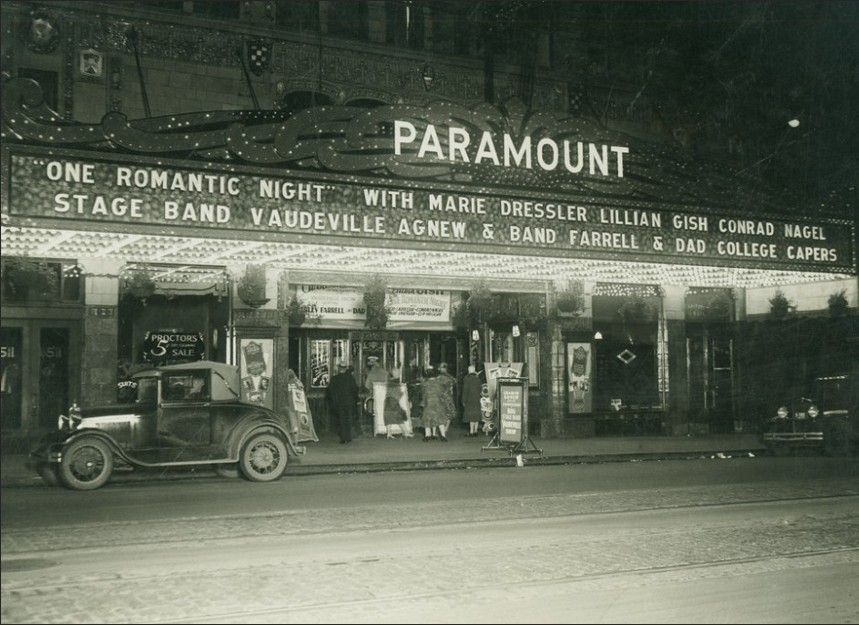
[“Marquee of the Paramount Theater, c. 1930,” Des Moines Pioneer Club Collection, State Historical Society of Iowa.]
Paramount Theater resided at 511 Grand Avenue in downtown Des Moines. It’s vertical neon sign lit up the night.44
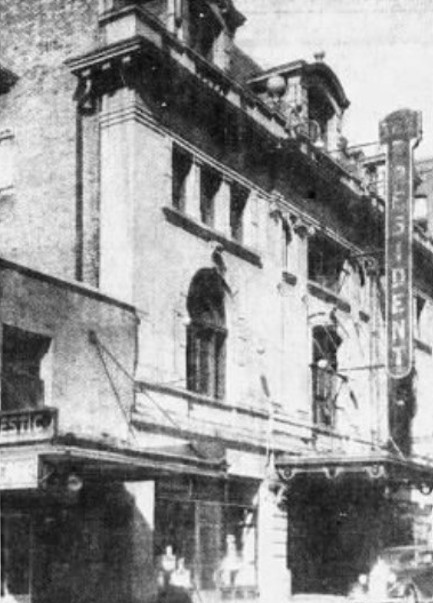
[“It’s Day Is Over.” Photograph. Des Moines Register (Des Moines, Iowa), March 11, 1938, 1.]
Not all movie theaters used Hollywood to entertain a crowd. Some theaters like The President in downtown Des Moines showed burlesque.45
Locations
The Des Moines River divides the city into thirds. North was upper middle-class neighbor-hoods. East had industry, fairgrounds, and the Capitol. The west had commerce and wealth.46
North
North Des Moines was its own city prior to Des Moines’ annexation spree in the late 1890s. The area’s growth was fueled by the streetcars. By the mid-20th century, it was a strong middle-class neighborhood.47
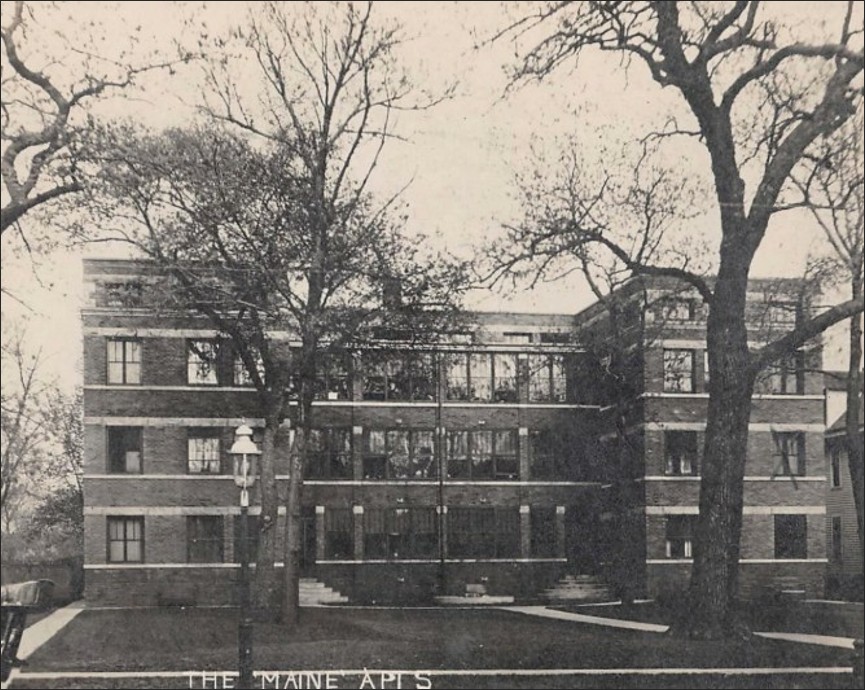
[Maine Apartments, Postcard (Des Moines, Iowa: Commercial Studio, 1918), accessed 31 June 31, 2024.]
Marrón Apartments I based loosely on the Maine Apartments. A three-story red brick apartment complex situated on 6th Avenue.48
Jewish Experience
I wanted to show Jewish people simply living their lives in 1930s Des Moines, Iowa. Interacting with those outside their faith was a big part of that. Ari Goldberg represents the second wave of Jewish immigration to Iowa, which began in the 1880s. These individuals came mostly from Eastern Europe, spoke Yiddish, and were more resistant to Americanization.49 Ira’s family represents the earlier wave of Jewish immigration who assimilated more quickly into the dominant culture in the mid-nineteenth century. Many of these immigrants were a part of the Reformed movement, and expressed their faith through social justice and community leadership, not through ritual observance.50
Jews were also subjected to redlining and housing discrimination. In Des Moines, a small but vibrant Jewish communities lived in Des Moines during the 1930s.51
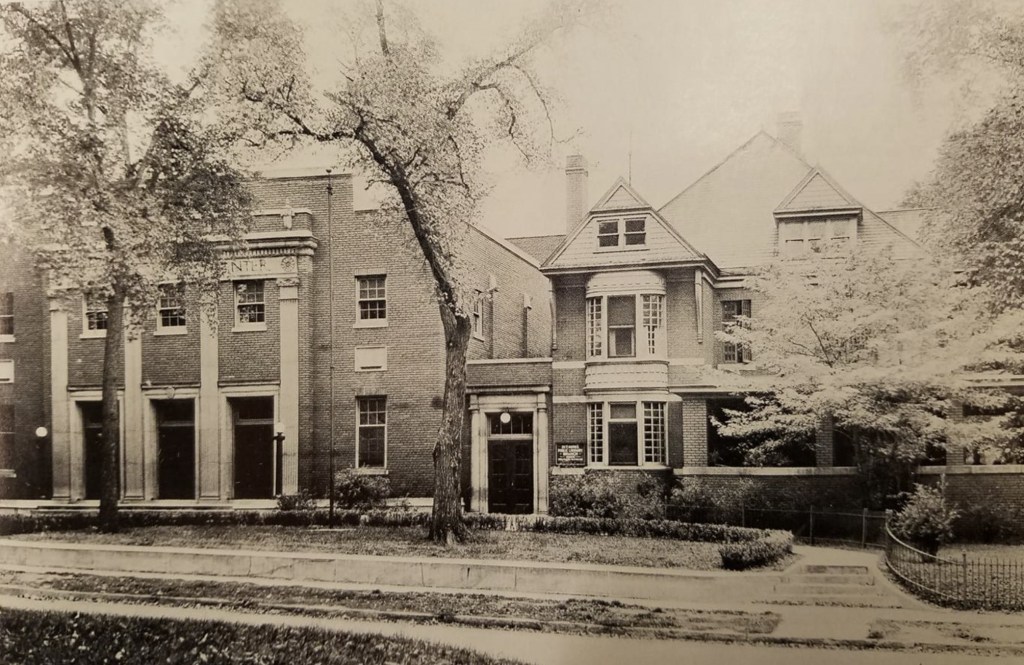
“Jewish Community Center, c. 1945,” Iowa Jewish Historical Society (closed Facebook group), April 10, 2025, access April 5, 2026.
Jewish Community Center was located at 8th and Forrest. It provided welfare and community services for Jews and Gentiles alike.52
Malin’s was a kosher Deli run by different owners from the 1920s to the 1980s.53
Highland Park
Des Moines University began as Highland Park College in 1890. It went through various ownership changes until a Baptist institution purchased the school in 1918. Alpha Gamma Kapa was established as a Des University fraternity in 1918. Their chapter house address was 3710 Third Street only a few blocks from the women’s dormitory, Child’s Hall, which sat along Second Avenue. Alpha Gamma Kapa dominated when competing against the other fraternities in intramural sports.54
I modeled Highland Park Auto Shop after Highland Garage which served the residents of Highland Park in the 1930s.55
East

[Tad Anderson, “Crews Load Historic Gas Station on Moving Truck Again,” KCCI, 5 November 2014, accessed: December 6, 2023]
Gas stations of the 1930s embraced a wide variety of agricultural styles. Just because it was a place to pump gas, it didn’t mean the building had to be boring. I modeled Anderson Auto Repair’s garage after a historic gas station on Des Moines’ east side. It was moved from its prior location in 2014 to save it from demolition.56
Hammer Pharmacy was one of Des Moines’ oldest pharmacies.57
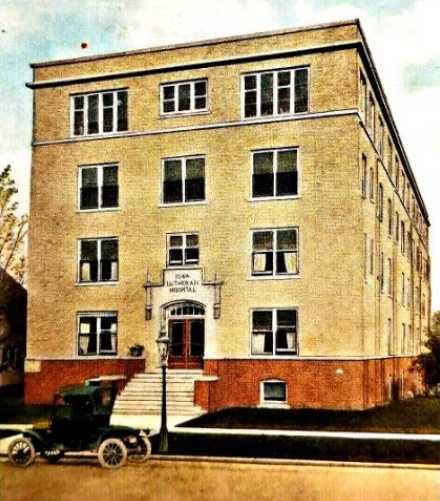
[Iowa Lutheran Hospital. Postcard. Enos B. Hunt, Des Moines, Iowa, ca. 1918.]
Lutheran Hospital was built in 1914 to serve the large Swedish Lutheran population on the east side of the Des Moines River. In 1937 it was one of several hospitals serving the community.58
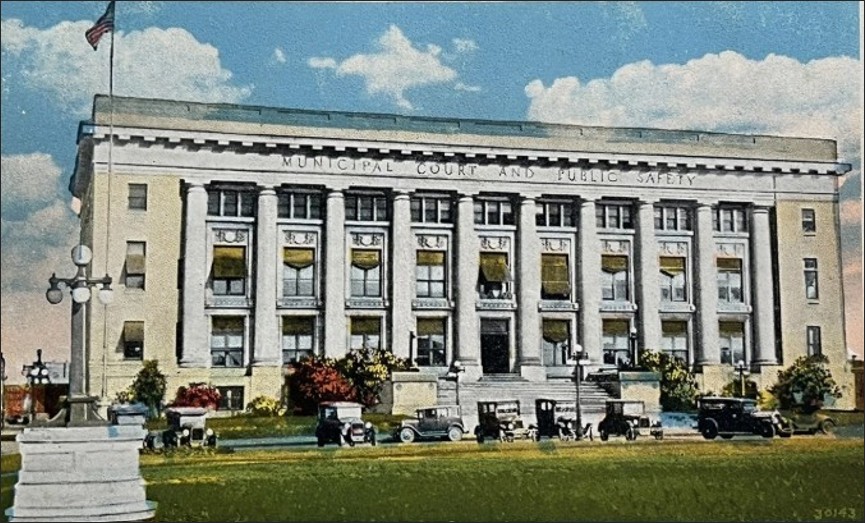
[Municipal Court and Public Safety, Des Moines, Iowa, Postcard (Des Moines, Iowa: Hyman’s News and Book Store, c. 1930, accessed October 05, 2025. ]
While World War I raged in Europe, the citizens of Des Moines were still able to approve a separate bond issue for the building of a new Municipal Court Building at a cost of $350,000. Chief of Police Joe Donoghue in 1920, considered the Beau Arts Building, “the finest police station in the middle west.” A few years later with the growing number of automobiles in the city and crime, the police department answered by establishing the auto theft bureau. As for prosecuting criminals, the police and prosecutors’ dynamics are often fraught with complications.59
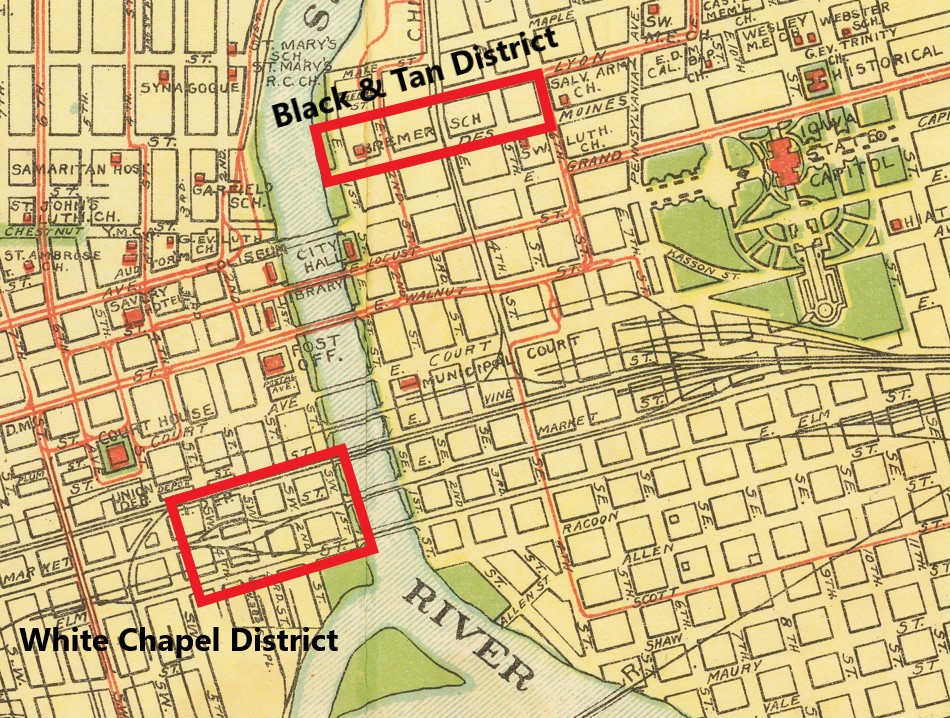
[Official Map and Guide of Des Moines, Midland Map and Engineering Company, 1920, Barry Lawrence Ruderman Antique Maps, Inc.]
White Chapel District was demolished with city funds in 1932. It had been Des Moines’ first redlight district. Vice moved to an area of Court Avenue during WWI, then moved to the “Black and Tan” district four blocks southeast of the Capital from 1920s – 1930s.60
West
Owl’s Head District
I based La Amarilla Apartment complex loosely on The Cortez Apartments located in the Owl’s Head Historic District on Des Moines’ west side. Many of the homes in this area were built for the wealthy, with architecture reflecting early 20th-century affluence. Originally part of Greenwood Park, the district was annexed by Des Moines during its expansion in the 1890s. Redlining maps later marked the area in solid green—signaling high desirability and, implicitly, racial exclusion. Non-white residents were typically barred, except as domestic workers, under restrictive housing practices common at the time.61
Center Street
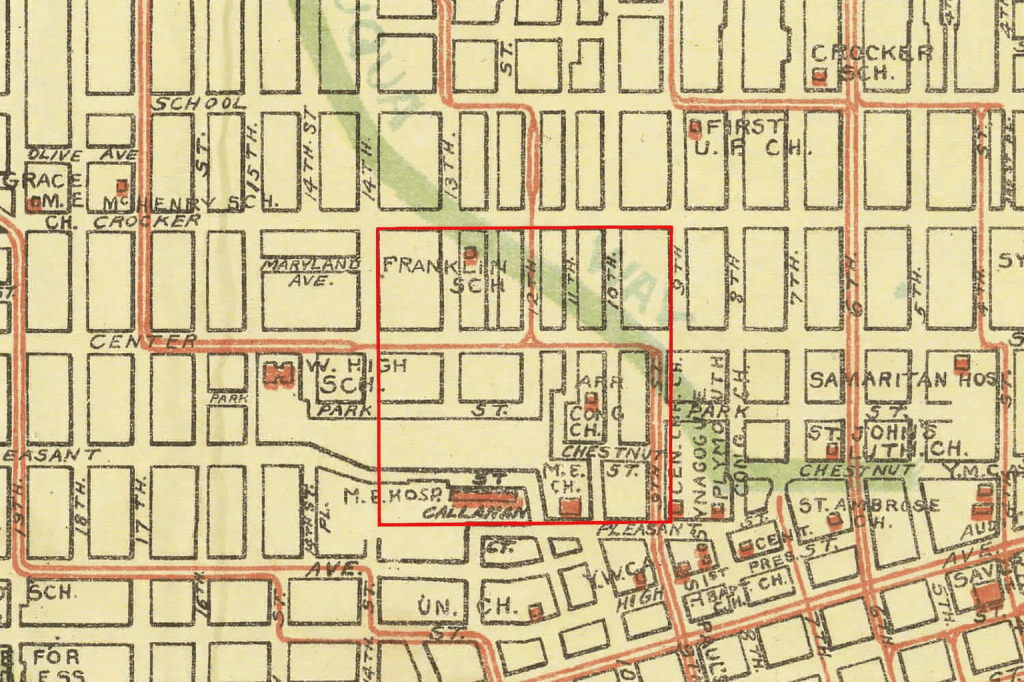
[Boundaries drawn from Thomas A. Gary, The Rise and Fall of Center Street, 1945–1972 (master’s thesis, Iowa State University, 2003); Official Map and Guide of Des Moines. Midland Map and Engineering Company, 1920.]
Center Street was the center of Black life in Des Moines. It had everything from business to nightclubs.62
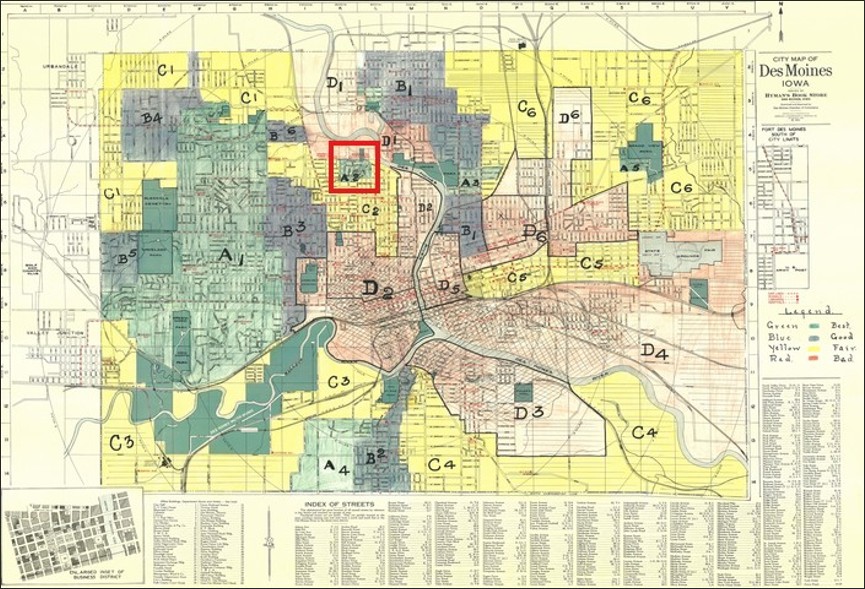
[I highlighted the location of Chautauqua Park on the Des Moines Home Owners’ Loan Corporation. Map. C. 1930 taken from Laura Belin, “Must-See Exhibit Chronicles Racist Housing Policies in Des Moines,” Bleeding Heartland, January 21, 2020.]
Restrictive covenants began at the development level, with racist language embedded in land deeds as properties were parceled and sold—limiting who could live in certain areas. In the 1930s, the federal government enshrined this prejudice through agencies like the HOLC and FHA, which institutionalized redlining and discriminatory lending. In the 1940s, Archie Alexander went to court to invalidate a restrictive covenant in Chautauqua Park, Des Moines—decades before the Fair Housing Act of 1968.63
Downtown
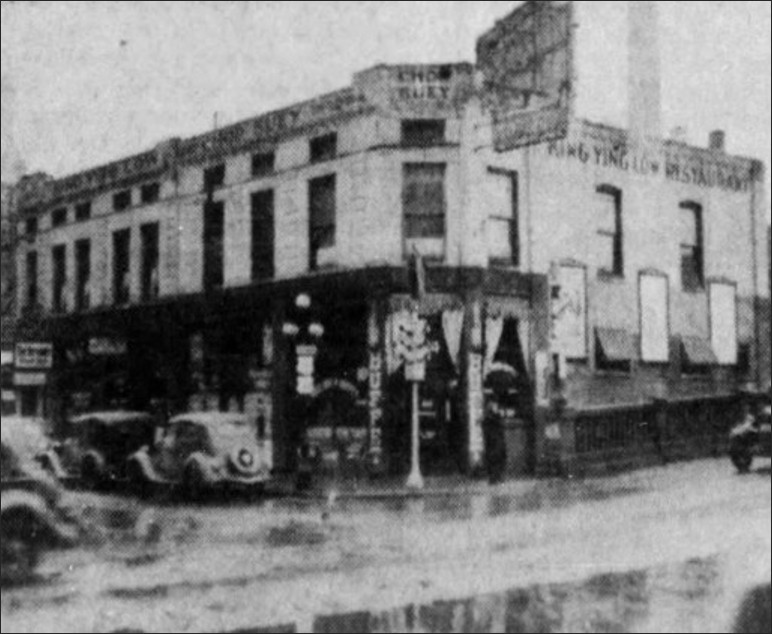
[“Razing Plans,” Photograph, Des Moines Tribune (Des Moines, Iowa), December 26, 1936, 3.]
King Ying Low was Des Moines oldest Chinese restaurant. Established in 1902, its location varied throughout the years. In 1937 it was located on the second floor of 618 Mulberry Street and did offer delivery services.64
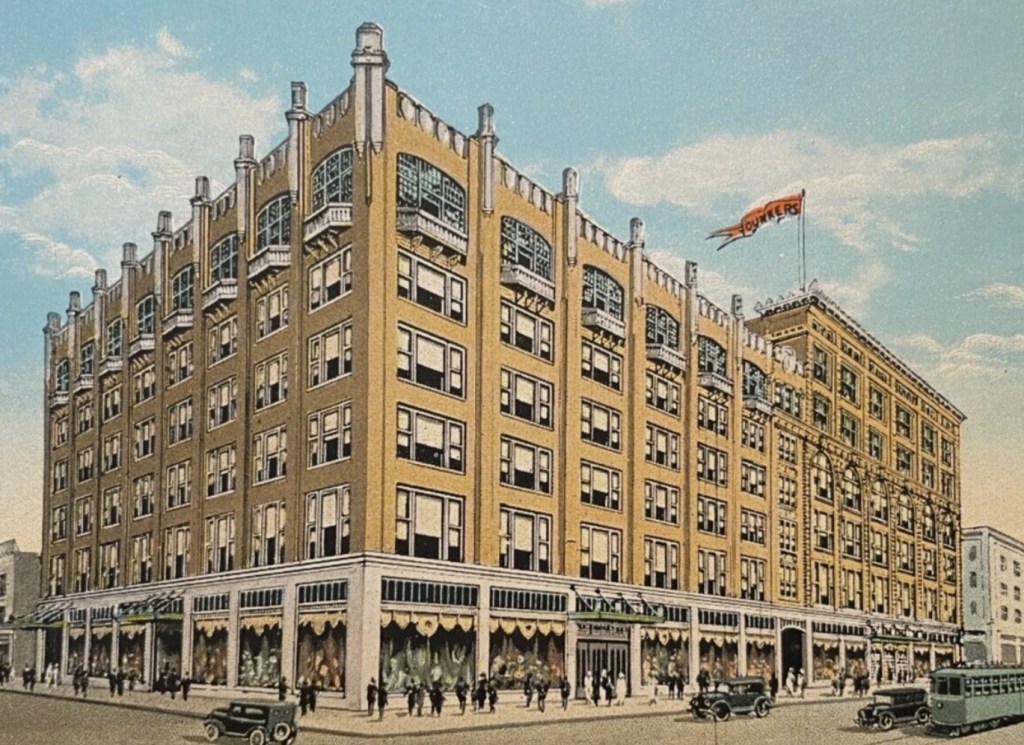
[The New Home of Iowa’s Foremost Store, Younker Bros., Des Moines, Postcard, (Chicago, Illinois) Curt Teich & Company, c1930, Lisa Taber Collection].
Levin’s Department Store is loosely based on Younker’s Department store in downtown Des Moines. By the 1940s it had sister stores in all of Iowa’s major cities. The owners had a very liberal view of their staff and customers. They hired women shop keepers in the 1890s. From the 1930s on, their credit department ensured women’s access to credit without a male co-signor well before the credit act in 1970s.65
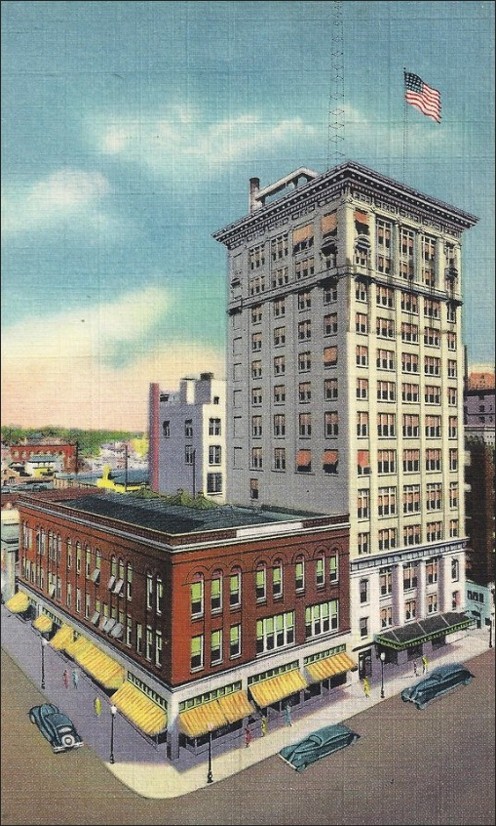
[Iowa’s Great Newspapers, The Des Moines Register and Tribune, Postcard (Hyman’s News and Book Store, Des Moines, Iowa, ca. 1940). Lisa Taber Collection.]
The Des Moines Register and Des Tribune occupied the basement and first four floors of the R&T Building. The remaining ten floors housed business. The Des Moines Register was the statewide paper and was printed in the morning. The Des Moines Tribune was the ‘local’ paper and was printed in the evening. Both papers were owned by the same company but maintained separate staff.66
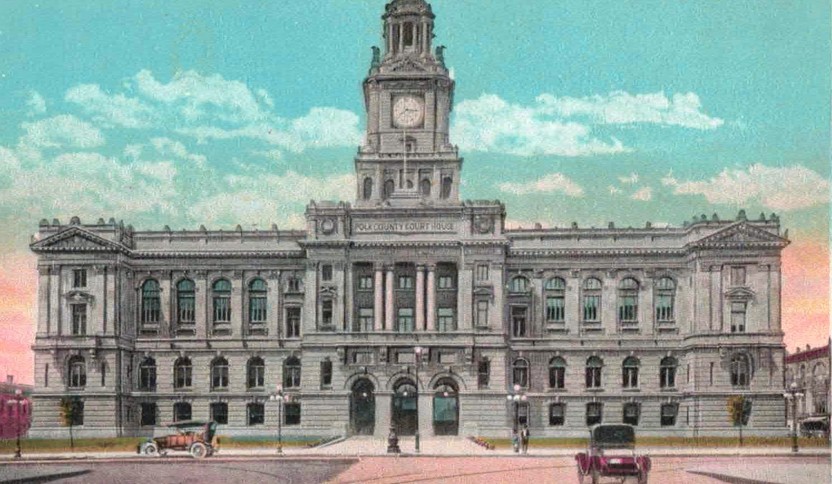
[A. O. Harpel, Polk County Courthouse, Postcard (Hyman’s News and Book Store, Des Moines, Iowa, ca. 1910).]
Built in 1906 on the former courthouse grounds. This building housed the criminal and civil courts of Polk County. To understand what Ira’s job as a judge on Iowa’s 9th District, I combed through Des Moines Tribune and The Des Moines Register articles from the 1920s & 1930s and ended up using judges Frank S. Shankland and Russell Jordan as examples.67
Outskirts
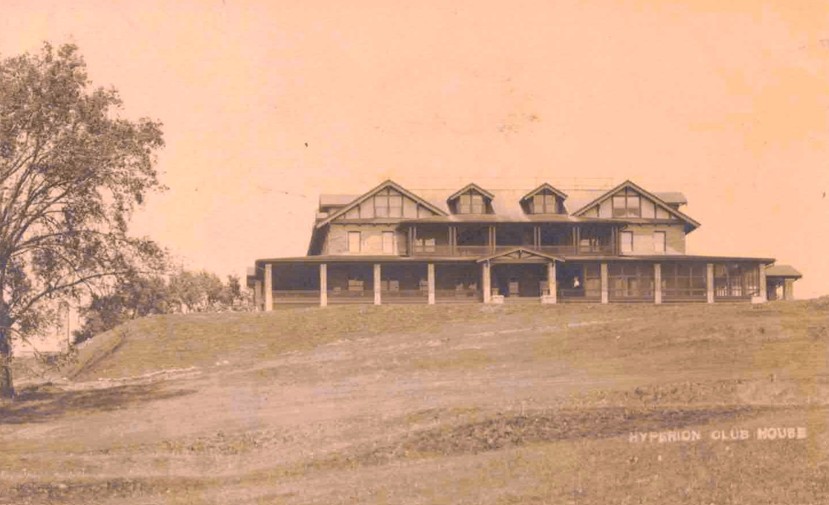
[Hyperion Club House, Postcard, ca. 1920. Lisa Taber Collection.]
The Parádeisos is loosely based on the Hyperion Golf Course. A private club that admitted Jewish members nearly half a century before the other Des Moines country clubs. Founded in 1900, Hyperion began as a motoring club where members would drive their cars, rent a room on the second floor of the club house, then return to Des Moines the following morning. The club expanded in the 1920s, adding a tennis court, swimming pool, and sports activities in the basement. The club ran into financial problems in the 1930s.68
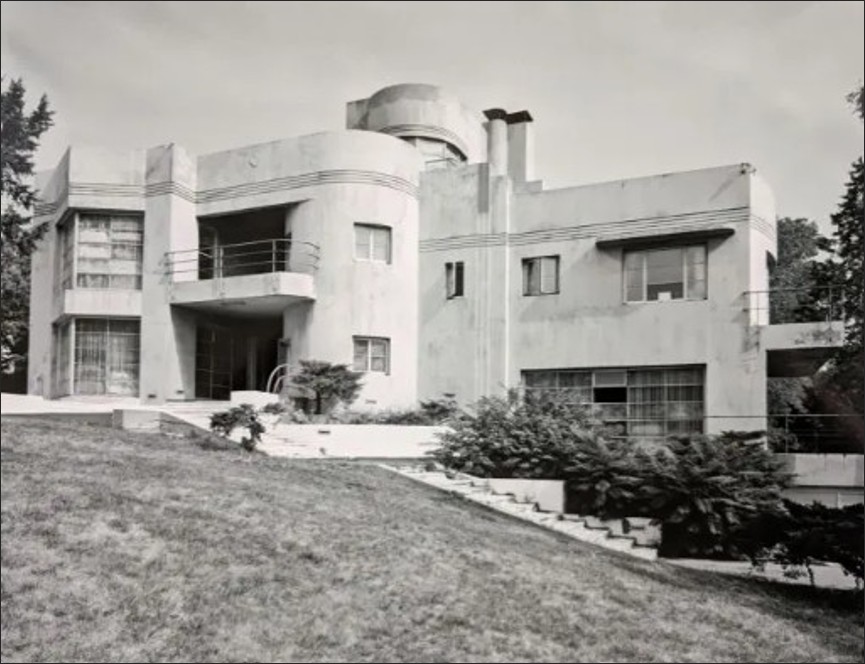
[Earl Butler Mansion, Press photograph, ca. 1940. Lisa Taber Collection.]
Streamline Moderne was a defining architectural trend of the 1930s, blending sleek curves and modern materials. Ira’s new house is loosely based on one of Des Moines’ most iconic homes, designed in 1937 by renowned architect Earl Butler. Sparing no expense, Butler included a ramp in place of stairs, a refrigerator, air-conditioning, and an early version of a garage opener—complete with an “electric eye” sensor.69
In 1915, the executor of Martin Flynn’s estate sold a swathe of the farm to the State of Iowa, which established the Clive Honor Farm—a minimum-security facility where prisoners produced goods for other state institutions. While historical records show continuous operation until 1967, I’ve taken liberties with history and kept the farm open during the 1930s for the purposes of this story.70
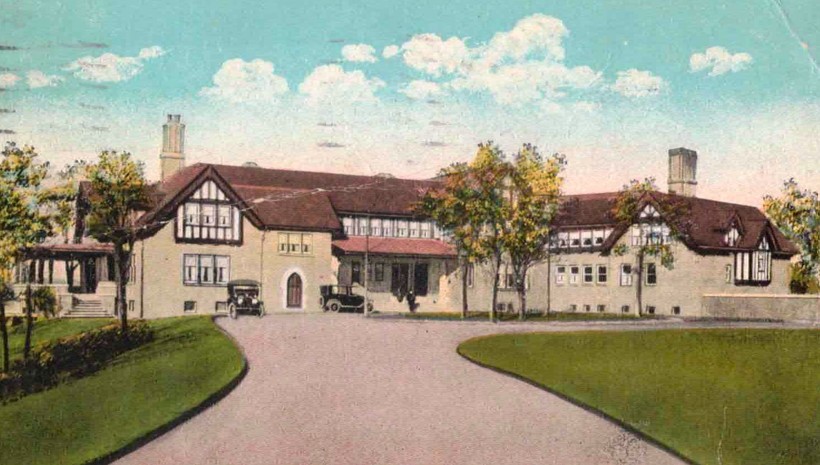
[New Wakonda Club, Des Moines, Iowa. Postcard (Hyman’s News and Book Store, Des Moines, Iowa, 1923). ]
Pinehurst Country Club is loosely based on The Wakonda Club. Built in 1920s on the southern outskirts of Des Moines, it was for “high class residence” meaning no minorities or Jewish members until the 1960s.71
People
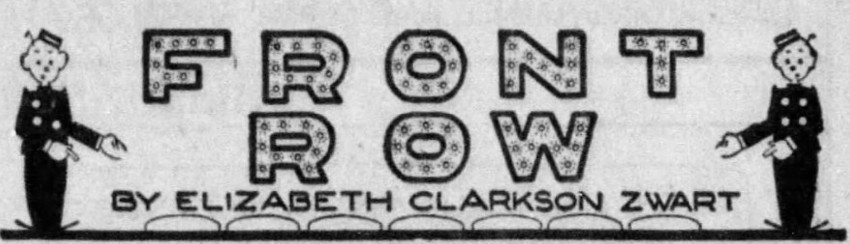
[Elizabeth Clarkson Zwart, “Front Row,” Des Moines Tribune (Des Moines, Iowa), 01 January 1937, 15.]
I modeled Mavis’ character after Elizabeth Clarkson Zwart, a well-known reporter for the Des Moines Tribune and The Des Moines Register for over half a century. Her “Front Row” society column ran in the Des Moines Tribune from the 1920s – 1940s.72
I based Paul and Laura Copeland loosely on the Potters. Potter Palmer made his fortunes in Northshore Chicago real estate. Many Chicago real estate developers were lured to Des Moines in the 1880s due to the housing boom. Michael Copeland was loosely based on Frederick Hubbell. A real estate developer and entrepreneur in Des Moines, Iowa. He owned much of the east side and downtown. Development of any kind had to go north or west.73
Governor Tiberius Powell is fictional. I wanted a big-bad foil for Evelyn and Ira. I used Iowa Governor William Harding (1917-1921), and John Jenney (head of Des Moines Public Safety in the 1920s) as actual and perceived examples of corruption.74
In 1909, Wilma Berger was walking near Lake Michigan after her nursing shift at Henrotin Hospital in Chicago when she was attacked by a middle-aged man. Feigning compliance, she used jiu jitsu to throw him off and escape. Skeptical police officers required her to demonstrate the technique at the station, where she reportedly threw a detective to the ground. Her ordeal was widely reported in newspapers. It was later revealed that Berger had trained under Tsunejiro Tomita, a renowned Japanese martial artist who operated a dojo in New York City.75
- “Auto Crash Injures Six Persons, Two Seriously, Treat Victims at Hospital,” Des Moines Tribune (Des Moines, Iowa), February 17, 1937, 11; Health Safety Environment University, “What A 1930 Car Crash Looks Like vs 2024 Crash,” YouTube video, November 6, 2024, accessed September 28, 2025; “Model A Crash?” Ford Barn, June 03, 2012, accessed March 01, 2022. ↩︎
- “Nash Promotional Film – 1932 – 1939,” Oldsmobile Garage, June 13, 2021, accessed August 21, 2025; Byron Olsen, Nash: 1936-1957, Photo Archive (Yellow Springs, Ohio: Ertel Publishing, Inc., 2003); Ronnie Schreiber, “The Three Ps of Motordom: Pierce-Arrow, Peerless, and…Panteras?” The Truth About Cars, April 24, 2014, accessed August 24, 2023. ↩︎
- Don Butler, Auburn, Cord, Duesenberg (Osceola, Wisconsin: Motorbooks International Publishers and Wholesalers, 1992); Instructions for the and Operation of Auburn Models 12-160 and 12-160 A (Auburn, Indiana: Auburn Automobile Company, 1932); “What is Freewheeling?” Skinned Knuckles: A Journal of Car Restoration, Lares Corporation (Cambridge, Minnesota), 2024, accessed: 31 January 2024. ↩︎
- “1937 Cord Supercharged Beverly Sedan,” Gilmore Car Museum, 2023, accessed November 9, 2023; “Cord 810,” Don Butler, Auburn, Cord, Duesenberg (Osceola, Wisconsin): Motorbooks International Publishers, 1992, p. 328; “Cord,” Beverly Rae Kimes and Henry Austin Clark, Jr., Standard Catalog of American Cars, 3rd edition (Iola, Wisconsin): Krause Publications, Inc., 1996. ↩︎
- “1920s Car Radio,” Antique Automobile Club of America, Online Forum, August 26, 2000, Accessed: 5 January 2024; Franklin Olympic Instruction Book, Series 18 (Syracuse (New York: Franking Automobile Company, 1933. Reprinted by The H.H. Franklin Club. Las Vegas, Nevada: 2021); Sinclair Powell, The Franklin Automobile Company, Second edition (Cazenovia, New York: The H.H. Franklin Club Inc., 2014). ↩︎
- “Ford Motor Company in Central Iowa: A Historic Presence from Model T to Model A,” Central Iowa Model A Ford Club, 2025; “Gilmore Car Museum,” L. M. Elm, Historical Novelist, 2023, accessed January 14 2024; Ray Miller and Glenn Embree, Henry’s Lady: An Illustrated History of the Model A Ford (Oceanside, California; The Evergreen Press, 1972). ↩︎
- “Cadillac & La Salle,” Cars of the 1930s, pp. 14-19; “Prices Talk! Looks These Over,” The Des Moines Register (Des Moines, Iowa), 28 June 1937, 13; Robert Werrbach, “1932 LaSalle Tow Truck,” Pre-War Automobile Classic Images (Facebook group) February 22, 2020, accessed December 15, 2022. ↩︎
- “1935 Oldsmobile F-35 Touring Sedan,” Bonhams Cars, 2019, accessed December 14, 2024; “De Wall Moters Inc.,” Des Moines Register (Des Moines, Iowa), 01 February 1937, 15; “Oldsmobile & Viking,” Cars of the 30s, 62-64. ↩︎
- Arthur W. Einstein, Jr, ‘Ask the Man Who Owns One’: An Illustrated History of Packard Advertising (New York: McFarland and Company, 2016); John Heitmann, “1937 Packard 120 — The Perfect Car for a Woman’s Personal Use,” The Automobile and American Life , April 21 2018, accessed November 6, 2023, ; Packard 12 Series 1406, 1407 and 1408 Owner’s Manual (Packard Motor Car Company, 1935); “Peverills and the Automobile 1906-1952,” Amherst College Digital Collection, accessed November 7, 2023 ; “Radiator Cap Ornaments,” Packard Motor Museum, 2017, accessed: January 9, 2020; “Your Money May Never Go This Far Again,” Des Moines Tribune (Des Moines, Iowa), May 17, 1937, 9. ↩︎
- “1932 Pierce Arrow Model 54 Club Sedan,” Gilmore Car Museum, 2023, accessed November 9, 2023; Cars of the Classic 30s, 195; Cars of the 1930s, 70-73. ↩︎
- “Depression of 1937,” Digital History, 2021, accessed: November 6, 2023; Douglas Irwin, “What Caused the Recession of 1937–1938?” Vox, September 11, 2011, accessed February 9, 2020; Jonian Rafti, “Roosevelt’s Recession: A Historical and Econometric Examination of the Roots of the 1937 Recession,” Inquiries 7, no. 06 (2015), accessed 09 February 2020. ↩︎
- Daniela Turudich, Art Deco Hair: Hairstyles from the 1920s & 1930s (Streamline Press, 2013); Tammy Ward and Tina Skinner, Fashionable Clothing from the Sears Catalogs: Late 1930s (Atglen, Pennsylvania: Schiffer Publishing, 2006); “Vintage Maternity Series – The 1930s,” Flashback Summer, July 02, 2019, accessed August 25, 2024. ↩︎
- “Classic Waldorf Salad,” The Conservation Foundation, February 19, 2019, accessed July 24, 2024; “History of Waldorf Salad,” Quaint Cooking, November 14, 2019, accessed November 20, 2022; George Rector, The Rector Cook Book (Chicago, Illinois: Rector Publishing Co., 1928), 126, HathiTrust, accessed October 4, 2025. ↩︎
- Mildred Grosberg Billin, The Jewish Cookbook (New York: Bloch Publishing Company, 1946); “Chicken Paprika with Rice,” Tina Lohman, The Book of Jewish Recipes (New York: The National Jewish Post, 1942), 90-1; Leah Koenig, The Jewish Cookbook (New York: Phaidon, 2019). ↩︎
- J. M. Barrie, Peter Pan, 1911 (New York: Harper Collins, 2003); “Baker-Trisler Co.,” The Register and Leader (Des Moines, Iowa), December 12, 1908, Book section, 5; “The Fairyesque Extravaganza Jand and Jill,” The Des Moines Evening Tribune (Des Moines, Iowa) November 11, 1909, 2. ↩︎
- Robert Byrne, McGoorty: A Pool Room Hustler (New York, New York: Broadway Books, 2004); Cathy Moran Hajo, “Tracing One Package,” The Margaret Sanger Papers Project, New York University, accessed September 24, 2025; Hunter Oatman-Stanford, “Getting It On: The Covert History of the American Condom,” Collectors Weekly, August 2012, accessed September 24, 2025. ↩︎
- Collection of sexual aids in a wooden box, Japan, 1930-1939. Item # A641105S. Science Museum Group Collection Online, accessed October 18, 2023; Sun Laichen, “Burmese Bells and Chinese Eroticism: Southeast Asia’s Cultural Influence on China,” Journal of Southeast Asian Studies 38, no. 2 (2007): 247–73; Bill Mihalopoulos, Sex in Japan’s Globalization, 1870–1930: Prostitutes, Emigration and Nation-Building (New York: Routledge, 2016). ↩︎
- Noah Berlatsky, Wonder Woman: Bondage and Feminism in the Marston/Peter Comics, 1941-1948 (Newark, New Jersey: Rutgers University Press, 2015); Joy Hendry, Wrapping Culture: Politeness, Presentation, and Power in Japan and Other Societies (New York: Oxford University Press, 1993); Jill Lepore. History of Wonder Women (New York: Knopf, 2014). ↩︎
- Babe Bisignano, Interview (Des Moines, Iowa), Iowa Oral History Project, 1989, Internet Archive, February 18, 2019, accessed: August 25, 2023; “Smokers, Saloons, and the Mighty Sullivan,” Black Diamond History, July 8, 2020, accessed August 08, 2020, ; Sec Taylor, “Boxing Commissions,” The Des Moines Register (Des Moines, Iowa), February 16, 1937. ↩︎
- “Escobar Stops Bank,” The Des Moines Register (Des Moines, Iowa), June 22 ,1935, 5; David Fellerath, “How Cinderella Man Sucker Punches the Jewish Boxer Max Baer,” Slate, June 02, 2005, accessed October 23, 2020; Jeremy Schapp, Cinderella Man (New York: Houghton Mufflin Company, 2005). ↩︎
- Marcia Chambers, The Unplayable Lie: The Untold Story of Women and Discrimination in American Golf (New York: Simon and Schuster, 1995); Glenna Collett, Golf for Young Players (Boston, Massachusetts: Little, Brown, and Company, 1926); Glenna Collett, Ladies in the Rough (New York: Alfred A. Knopf, 1929). ↩︎
- Dr. Sarah Eikleberry, “Camping While Black: African American Experiences in Iowa Summer Camps, 1925–1950,” History 101, Iowa State Historical Society, Zoom lecture, accessed January 13, 2022; “Making the Rounds of Des Moines Camps with Tribune Cameraman,” Des Moines Tribune (Des Moines, Iowa), July 05, 1937, 18; Gary P. Zola, “Jewish Camping and Its Relationship to Organized Camping Movement in America” in A Place of Our Own: The Rise of Reformed Jewish Camping, Michael M. Lorge and Gary P. Zola, editors (Tuscaloosa, Alabama: The University of Alabama Press, 2006). ↩︎
- Jerry Harrington, “Iowa’s Liquor-By-the-Drink Conflict,” Iowa History Journal, January/February 2020, 8-11; “Liquor Store Employees Prepare for Opening Sale Tuesday Morning,” Des Moines Tribune (Des Moines, Iowa), June 18, 1934, 20; “Permit Book for Iowa Liquor Buyers,” Des Moines Tribune (Des Moines, Iowa), May 10, 1934, 1. ↩︎
- “Beer License Drive Planned,” The Des Moines Register (Des Moines, Iowa), June 25, 1925, 3; Paul Phipps. “Vintage 1930s Beer Ads,” Retro Waste, accessed 22 January 2024; “Where Beer is Sold,” Des Moines Tribune (Des Moines, Iowa), February 20, 1937, 7. ↩︎
- “’Black Maria’ Hauls Women to City Jail,” The Des Moines Register (Des Moines, Iowa), October 09, 1938, Section 6, p. 1, 8; “New Night Club to Open Friday,” The Des Moines Register (Des Moines, Iowa) May 16, 1935, 1; Elizabeth Clarkson Zwart, “Front Row,” Des Moines Tribune (Des Moines, Iowa), December 16, 1931, 15. ↩︎
- Chuck Chambers, The Private Investigator’s Handbook (New York: Penguin Books, 2005); Code of Iowa (Des Moines: State of Iowa, 1931), §§ 10475–10476, chap. 471, “Divorce and Annulment of Marriages: Causes”; Graham Moulton, “I Spy,” Life, September 22, 1947, 65-68. ↩︎
- H. Irving Hancock, Jiu-Jitsu Combat Tricks (New York: G. P. Putnam’s Sons, 1904), 81, Internet Archive, November 26, 2019; “Jiu Jitsu School,” The Des Moines Register (Des Moines, Iowa), February 27, 1923, 12; Knight Jiu-Jitsu, “Five Chokes Everyone Needs to Know (Well, Five-ish anyway), Jiu-Jitsu Fundamentals,” YouTube video, November 26, 2019, accessed February 17, 2025; Noguchi Senryuken, Jujutsu (1913), trans. Eric Shahan (Eric Michael Shahan, 2020), 124, 131; Wendy Rouse, Her Own Hero: The Origins of the Women’s Self-Defense Movement (New York: New York University Press, 2017).
Yoshiaki Yamashita Photograph Album (PH 006), Special Collections and University Archives, W.E.B. Du Bois Library, University of Massachusetts Amherst, accessed: 19 May 2023. ↩︎ - “Carbon Copy,” Preservation Self-Assessment Program, University of Illinois at Urbana-Champaign. 2022, accessed February 4, 2024; “Office Supplies,” Des Moines Tribune (Des Moines, Iowa), January 14, 1935, 2; “Testifies She Sold Secrets,” Des Moines Tribune (Des Moines, Iowa), April 30, 1935, 5. ↩︎
- Dr. Hans Gross, Criminal Investigation (London: Sweet, Maxwell, Limited, 1934); Willard D. Morgan and Henry M. Lester, Graphic Graflex Photography: The Master Book for the Larger Camera, fifth edition (New York: Morgan & Lester Publishers, 1943); Anne Wingate, Ph.D, Scene of the Crime, The Howdunit Series (Cincinnati, Ohio: Writer’s Digest Books, 1992). ↩︎
- Ansel Adams, The Camera (New York: Little, Brown, and Company, 1980); Christopher Bonanos, Flash: The Making of Weegee the Famous (New York: Henry Holt and Company, 2018); Mia Fineman, “Kodak and the Rise of Amateur Photography,” The Met, October 2004, accessed February 9, 2020; “Geppert Studios,” The Des Moines Register (Des Moines, Iowa), March 15, 1935, 5; Todd Gustavson, 500 Cameras: 170 Years of Photographic Innovation (New York: Sterling Publishing, Inc., 2011); “Kodak Self Timer, Photographic Accessory,” Vintage Camera Museum, 2020, accessed 17 November 2022; Willard D. Morgan and Henry M. Lester, Graphic Graflex Photography: The Master Book for the Larger Camera (New York: American Book—Stratford Press Inc., 1943); Paul-Henry van Hasbroeck, Leica: A History Illustrating Every Model and Accessory (New York: Sotheby Publications, 1993); “‘Speed’ with the Original Minatare Candid Camera, Leica,” The Des Moines Register (Des Moines, Iowa), 24 January 1937, Iowa News section, 2; ↩︎
- Lucille Bogan, “Shave ‘Em Dry,” Shave ‘Em Dry: The Best of Lucille Bogan, compact disc (New York: Sony, 2004); L.M. Elm, “The Profane Angel,” L. M. Elm, Historical Novelist, March 16, 2024, accessed July 24, 2024, Watchwinder, “My Man Godfrey Outtakes and Bloopers,” Youtube, January 2, 2008, accessed March 01, 2024. ↩︎
- Daniel Delis Hill, American Menswear From the Civil War to the Twenty-First Century (Texas Tech University Press, 2011, 109, 155); Daniel Sugarman, “Pocket Watch Belonging to Jewish Titanic Victim Sold at Auction,” The Jewish Chronicle, August 28, 2018, accessed March 24, 2022; Jeff Schogol, “How World War I Soldiers Gave America the Wristwatch,” Task & Purpose, December 28, 2023, accessed March 01, 2024. ↩︎
- Desire, Frank Borzage, director, with Marlene Dietrich, Gary Cooper, and John Haliday. Universal. DVD 2016. 125 minutes; Mr. Deeds Goes to Town, Frank Capra, director, with Gary Cooper, Jean Arthur, and George Bancroft. DVD. Sony, 2008. 115 minutes; Morocco, Josef von Sternberg, director, with Marlene Dietrich, Gary Cooper, Adolphe Menjou. Universal. DVD. 92 minutes. ↩︎
- CaptainComedia, “Hollywood on Parade – Durante, Vallee, Stooges, Turpin (1934),” YouTube video, September 19, 2009, accessed March 17, 2024; “Hollywood on Parade # B-9 (1934),” The Three Stooges Online Filmography, 2022; “Jimmy Durante,” Hollywood Walk of Fame, 2022, accessed March 17, 2024, ↩︎
- “1932 Packard Coupe Roaster and Owner Clark Gable,” The Making of Modern Michigan, 2020, accessed March 17, 2024; “Clark Gable Has Lead in ‘San Francisco’ at Des Moines.” Society Section, The Des Moines Register (Des Moines, Iowa), July 5, 1936, 6; San Francisco. W.S. Van Dyke, director. With Clark Gable, Jeanette MacDonald, Spencer Tracy, Jack Holt, and Jessie Ralph. Studio Services. DVD. 115 minutes. 2006. ↩︎
- Racconti della Vecchia Hollywood, “Carole Lombard and George Raft, Bolero, 1934,” YouTube video, August 14, 2022, accessed March 17, 2024; Larry Swindell, Screwball: The Life of Carole Lombard (New York: William Morrow and Company, Inc.,1975); Jerry Vermilye, Profane Angle: the Life and Career of Carole Lombard (New York: McFarland, 2023). ↩︎
- After the Thin Man, directed by W.S. Van Dyke, with William Powell & Myrna Loy. Warner Brothers, 2007. DVD. 112 minutes; Roger Fristoe, “Myrna Loy Profile – Myrna Loy – 8/2,” Turner Classic Movies, June 25, 2012, accessed April 5, 2026; The Thin Man, directed by W.S. Van Dyke, with William Powell, Myrna Loy, & Maureen O’Sullivan, 2007. Warner Brothers, 2007. DVD. 93 minutes. ↩︎
- Shirley Temple Black, Child Star: An Autobiography (New York: McGraw-Hill, 1988); Anne Edwards, Shirley Temple: American Princess (New York: William Morrow and Company, Inc., 1988); Poor Little Rich Girl. Directed by Irving Cummings. Featuring Shirley Temple, Alice Faye, Gloria Stuart, Jack Haley, and Michel Whalen. La Entertainment, 2021. DVD, 72 min. ↩︎
- Joan Wester Anderson, Forever Young: The Authorized Biography of Loretta Young (Ave Maria Press, 2000); Classicos do Cinema, “Trailer – The Crusades -as Crusades – 1935 Full HD,” Youtube, April 2023, accessed: April 28, 2024; “Loretta Young Biography,” Internet Movie Database, 2024, accessed April 28, 2024, ↩︎
- Faith Service, “She Tells on Garbo,” Modern Screen 14, no 2 February 1937 (Dell Publishing Company, Inc.): 37; Modern Screen (December 1936 – November 1937), Dell Publishing Company, Internet Archive, accessed 10 April 2023; “Modern Screen,” Pulp and Old Magazines, September 14, 2018, accessed April 10, 2023, . ↩︎
- Pamela Hutchinson. “Photoplay Magazine: The Birth of Celebrity Culture,” The Guardian, January 26, 2016, accessed August 23, 2023; “Photoplay,” The Online Books Page, 2023, accessed August 23, 2023; Photoplay, 1, Volume 51 (Chicago, Illinois: Macfadden Publications, Inc., 1937). ↩︎
- “Paramount,” Des Moines Tribune (Des Moines, Iowa), February 18, 1937, 15; “The Plainsman,” Cecil B. DeMille, director, with Cary Cooper, Jean Arthur, James Ellison, Charles Bickford, Gabby Hayes, and Anthony Quinn, 1936, Internet Archive, 108 minutes, accessed: June 08, 2025; “The Plainsman (1936),” I Review Westerns, November 1, 2022, accessed June 08, 2025. ↩︎
- “Humota Theater,” The Humbolt Republican (Humbolt, Iowa) January 29, 1937, 4; “Tarzan’s Dainty Mate Dons More Clothes,” The Des Moines Register (Des Moines, Iowa), August 30, 1936, 73; Tarzan Escapes. Directed by Richard Thorpe, George B. Seitz, and William A. Wellman. Featuring Johnny Weissmuller and Maureen O’Sullivan. In The Tarzan Collection. Burbank, CA: Warner Brothers, 2005. DVD, 8 hr. 47 min. ↩︎
- “Entrance and Marquee of the Paramount Theater,” Des Moines Pioneer Club Collection, State Historical Society of Iowa, accessed January 14, 2024, ; “Marquee of the Paramount Theater, c. 1930,” Des Moines Pioneer Club Collection, State Historical Society of Iowa, accessed January 14, 2024; “Paramount Theater, c. 1930,” Des Moines Pioneer Club Collection, State Historical Society of Iowa, accessed January 14, 2024. ↩︎
- “At the President,” Des Moines Tribune (Des Moines, Iowa), February 12, 1937, 11; “President,” Des Moines Tribune (Des Moines, Iowa), January 16, 1937, 3; “31 Years Old Theater Bows to Parking Lot,” Des Moines Tribune (Des Moines, Iowa), March 11, 1938, 1, 4. ↩︎
- James E. Jacobsen, In the Shadow of the State Capitol: An Architectural Historical Survey of the Capitol East Neighborhood, Des Moines, Iowa: A Study (Des Moines, Iowa: History Pays!, 2002); Hope Mitchell, East Village, Des Moines: A Brief History (Charleston, South Carolina: History Press, 2016); A Preliminary Major Street Plan for Des Moines, Iowa (Des Moines, Iowa: City of Des Moines, 1925), accessed February 28, 2025. ↩︎
- “Highland Park,” Audubon Republican (Audubon, Iowa) August 21, 1890, 1; James E. Jacobsen, “If They’d Just Blow Up the Bridges, We Would be All Right”: A History of Highland Park, Oak Park and the ‘Parks District’ of Des Moines, Iowa, 1888-1997 (Des Moines, Iowa: The Parks Business Association, 1997); William C. Page, Towards a Greater Des Moines: Early Suburbanization and Development, circa 1880-circa 1920: also Including an Intensive Survey of the River Bend Neighborhood (Des Moines, Iowa: Planning and Zoning Department City of Des Moines, 1992). ↩︎
- “New Apartments,” The Register and Leader (Des Moines, Iowa), 8 June 1913, classified section, 3; The Maine Apartments, Postcard (Des Moines, Iowa: Des Moines Commercial Studio, 1918); William C. Page, The Maine, National Park Service, United States Department of Interior: National Park Service, 16 September 1996. ↩︎
- Anita and Howard Cooper, Living a Jewish Life: Jewish Traditions, Customs, and Values for Today’s Families (New York: William Morrow, 2007); Jack Seymour Wolfe, Century with Iowa Jewry, 1883-1940 (Des Moines, Iowa: Iowa Print and Supply Company, 1941); Eli Wald, “The Rise and Fall of the WASP and Jewish Law Firms,” Stanford Law Review 60, no. 6 (2008): 1803–66. ↩︎
- “Dr. Goldenson to Be Speaker, Dedicate New Jewish Temple Tonight,” The Des Moines Register (Des Moines, Iowa), January 29, 1932, 9; Amos Elon, The Pity of It All: A Portrait of the German-Jewish Epoch, 1743-1933 (New York: Picador, 2002); Yidl in the Middle: Growing Up Jewish in Iowa. Directed by Marlene Booth. New Day Films, 1999. ↩︎
- Beryl Satter, Family Properties: Race, Real Estate, and the Exploitation of Black Urban America (New York: Henry Holt and Company, L.L.C., 2009); Daniel Schere. “Researchers Look at Where Jews and Blacks Weren’t Allowed to Go,” Washington Jewish Week, online Edition, May 10, 2017, accessed August 24, 2023, ; Tifereth Isreal Synagogue Services, October 24, 1930,” Iowa Jewish Historical Society (Facebook group), January 21, 2023, accessed: August 23, 2023. ↩︎
- “Jewish Community Center Dedication Exercise, 1925,” Iowa Jewish Historical Society (Facebook group), January 21, 2023, accessed: August 23, 2023; Jewish Community Center Twenty-fifth Anniversary: 1907-1932 (Des Moines, Iowa), 1932; “Lunchtime at Home Camp at the Jewish Community Center Gymnasium, c. 1950,” Iowa Jewish Historical Society (Facebook group), June 20, 2019, accessed: August 23, 2023. ↩︎
- Mike Kilen, “Soul of Sixth Avenue,” The Des Moines Register (Des Moines, Iowa), March 10, 2002, Iowa Life section, 1; William C. Page, Bernstein-Mailin Grocery, United States Department of Interior, Park Service, 21 September 1998; “Wrigley’s Gum,” Des Moines Tribune (Des Moines, Iowa), November 2, 1937, 3. ↩︎
- “Frat at D.M.U. Feels Imperiled By Girl Smoker,” The Des Moines Register (Des Moines, Iowa) January 26, 1926, 1; “Fraternities in Initiation,” Des Moines Tribune (Des Moines, Iowa), March 06, 1926, 13; Johnson Halls Wins Meet at Des Moines University,” Des Moines Tribune (Des Moines, Iowa), 22 April 1922, 3. ↩︎
- Highland Park Business District, 1930s (Des Moines, Iowa), Highland Park Business District, 2003. DVD. 25 min; James E. Jacobsen, “The Highland Park Historic Business District at Euclid and Sixth Avenues,” National Register of Historical Places Registration Form, United States Department of Interior National Park Service, June 09,1998, accessed: August 04, 2025; James E. Jacobsen, “If They’d Just Blow Up the Bridges, We Would be All Right”: A History of Highland Park, Oak Park and the ‘Parks District’ of Des Moines, Iowa, 1888-1997 (Des Moines, Iowa: The Parks Business Association, 1997). ↩︎
- Tad Anderson, “Crews Load Historic Gas Station on Moving Truck Again,” KCCI, 5 November 2014, accessed: December 6, 2023; David O. Lyon, “Chapter Four: Shell Station, a 1930s Era Replica,” in The Gilmore Car Museum: Miles from the Ordinary (Virginia Beach, VA: The Donning Company Publishers, 2010); Sarah Oltrogge, “Agreement Reached to Move and Preserve Historic Gas Station,” Preservation Iowa, March 15, 2009, accessed December 6, 2023; “Service Stations,” Architectural Forum 66, no. 2 (1937): 86–95. ↩︎
- “Hammer, 89, Druggist 60 Years, Dies,” The The Des Moines Register (Des Moines, Iowa), 5 October 1937, 1; Patt Johnson, “The East Village is Losing One of Its Oldest Businesses,” The Des Moines Register (Des Moines, Iowa), April 10, 2017, accessed: April 9, 2023; Elizabeth Clarkson Zwart, “Front Row,” Des Moines Tribune (Des Moines, Iowa), December 02, 1936, 15. ↩︎
- Doug Corbin, “Iowa Lutheran Hospital School of Nursing Graduating Class of 1938,” Lost Des Moines (closed Facebook group), September 28, 2017, accessed February 09, 2025; “Lutheran Hospital Opened to Public,” The Register and Leader (Des Moines, Iowa), March 9, 1914, 3; William Colgan Page, For the People’s Health (Des Moines, Iowa: Iowa Health System, 2005). ↩︎
- “Chief Donoghue Proud of New Police Station,” Des Moines Tribune (Des Moines, Iowa), June 14, 1920, 3; Martin Kaste, “It’s A Complicated Relationship Between Prosecutors, Police,” NPR, 4 December 2014, accessed September 13, 2020; Peggy Schleuger, “Auto Theft Bureau,” Behind the Badge, 72. ↩︎
- “All That Remains of White Chapel,” The Des Moines Register (Des Moines, Iowa), October 17, 1932, 12; Linda Banger, “Des Moines’ Past Red Light Districts.” and Steven Peglow in Tom Alex’s Behind the Badge: Stories and Pictures from the DMPD (Des Moines, Iowa: Des Moines Police Burial Association, 1999, 62-63); “Passing of Old White Chapel District Recalls Palmy Days of Late Nineties,” The Des Moines Register (Des Moines, Iowa), October 31, 1931, 1. ↩︎
- M. H. Bowers and S.J. Kingensmith, Owl’s Head Historic District, National Register of Historic Places Inventory – Nomination Form, October 11, 1978, accessed August 7, 2020;
“Cortez Apartment Sold,” Des Moines Tribune (Des Moines, Iowa), December 10, 1942, 21; Austin Wu, “The Bowery Street Grocery Store and Iowa City’s Omitted History of Segregation,” Little Village, August 5, 2020, accessed: July 25, 2023. ↩︎ - Paul Brennan and Courtney Guein, “Before I-235, Des Moines’ Center Street district was a bastion of Black Commerce and Culture,” Little Village, April 8, 2022, access January 14, 2024, ; Cecil H. Brewton, Jr., interview by Kim Poam Logan, The History of Jazz on Center Street in Des Moines, Iowa, YouTube video, October 23, 2013, accessed January 14, 2023; Jack Lufkin, “Patten’s Neighborhood,” Iowa Heritage Illustrated (Fall, 1996): 122-144. ↩︎
- Chautauqua Park Historic District, National Park Service, United States Department of Interior: National Park Service, February 5, 1990; “House Sale Challenged in Court Action,” Des Moines Tribune (Des Moines, Iowa), January 26, 1944, 11; Richard Rothstein, The Color of the Law (Liveright Publishing Corp, 2017). ↩︎
- Jamie Lauren Keiles, “The History of Jews, Chinese Food, and Christmas, Explained by a Rabbi,” Vox, December 25, 2020, accessed: February 26, 2021; “King Ying Low Café to Move,” The The The Des Moines Register (Des Moines, Iowa), 04 August 1940, 42; Lillian McLaughlin, “Ending 43 Years of Milk Route,” Des Moines Tribune (Des Moines, Iowa), 26 June 1971, 16. ↩︎
- “H.R.8163 – Equal Credit Opportunity Act,” United States Congress, Congress.Gov, 2023, accessed May 23, 2023, Kathryn Love, “Entertainment and Flappers,” (Des Moines, Iowa), Iowa Oral History Project, 1986, Internet Archive, November 21, 2011, accessed May 23, 2023; Kathryn Love, “The Working Girl During the Great Depression,” (Des Moines, Iowa), Iowa Oral History Project, 1986, Internet Archive, 14 November 2011, accessed November 21, 2021. ↩︎
- “Dozen Hurt at Flint, Troops Rush to Area,” The Des Moines Register (Des Moines, Iowa), February 02, 1937, 1; Kylie Munson, “Our Old Newspaper Building Now Is Luxury Lofts, But We Still Love It Like A Family a Farm,” The Des Moines Register, online edition (Des Moines, Iowa), 15 April 15, 2017, accessed September 08, 2021; “New Register-Tribune Building Scene of Varied Activity Now,” The Des Moines Register (Des Moines, Iowa), May 19, 1918, 11; “When You Visit the Register and Tribune Building Tomorrow,” The Des Moines Register (Des Moines, Iowa), June 13, 1918, 5; “Women Take Part in Strike Riot,” Des Moines Tribune (Des Moines, Iowa), February 2, 1937, 1. ↩︎
- “ArchitTreasures Polk County Courthouse Restoration,” Iowa Architectural Foundation, Youtube video, November 12, 2021, accessed: September 21, 2024; Judge Luther Thomas Clanton, the First Black Judge in Iowa, Interview, Des Moines, Iowa: Iowa Oral History Project, May 3, 1989, accessed: March 21, 2025; “Polk Judges Take Places,” The Des Moines Register (Des Moines, Iowa), December 16, 1937, 9. ↩︎
- Joseph W. Cowen, A Caddie Remembers: Golf in the 1930s (Bloomington, IN: AuthorHouse, 2004); Hyperion Club House, Postcard, ca. 1920. Lisa Taber Collection; Renda Lutz, “Club’s History Filled with Parties, Gambling,” The Des Moines Register (Des Moines, IA), August 31, 2004, 4. ↩︎
- David Gebhard and Gerald Mansheim, “Butler House (Now Kragie, Newell Advertising Agency),” Society of Architectural Historians, July 16, 2018, accessed February 24, 2024; “House for Earl Butler, Des Moines, Iowa,” Architectural Forum 67, no. 3 (1937): 179–86; “Iowa’s Concrete Houses of the 1930’s,” Architectural Observer, May 16, 2020, accessed February 24, 2024. ↩︎
- John Busbee, “Living History Farms: A Historical Time Machine that Celebrates Agri-History,” Iowa History Journal, online edition, 2020, accessed: May 9, 2023; “History of the Flynn Mansion and Barn,” Flynn Mansion Blog, Living History Farms, 2014, accessed: May 9, 2023; “Officer Must Return Fugitive, Says Woods,” Des Moines Tribune (Des Moines, Iowa), November 13, 1936, 17. ↩︎
- Julie Gammack, “Antisemitism Isn’t Far From Home, Yesterday and Today,” Iowa Capital Dispatch, online Edition, October 16, 2023, accessed October 21, 2024, ; New Wakonda Club, Des Moines, Iowa, Postcard, Des Moines, Iowa, (Hyman’s News and Book Store, c. 1930; “Morton Bookey – The Wakonda Deal,” Jewish Oral Histories, Jewish Federation of Greater Des Moines, 2024, accessed October 21, 2024. ↩︎
- Susan Caba and Valerie Monson, “Elizabeth Clarkson Zwart, ‘Front Row’ Columnist, Dies,” The Des Moines Register (Des Moines, Iowa), 02 July 1983, 1A, 2A; Elizabeth Clarkson Zwart, Manuscript Collection, Iowa Women’s Archives. The University of Iowa Special Collections (Iowa City, Iowa); “Front Row,” Des Moines Tribune (Des Moines, Iowa), April 24, 1934; ↩︎
- William B. Friedricks, Investing in Iowa: The Life and Times of F. M. Hubbell (Des Moines, Iowa: Iowan Books, 2007); “Frederick M. Hubbell Is Dead; Was Iowa’s Wealthiest Man,” Des Moines Tribune-Capital (Des Moines, Iowa), November 11, 1930, 1, 9; Sally Sexton Kalmbach, The Jewel of the Gold Coast (Chicago, Illinois: Ampersand, Inc., 2009). ↩︎
- Todd Dorman, “An Iowa Impeachment Drama, circa 1919,” The Gazette (Cedar Rapids, Iowa), online edition, March 16, 2019, accessed September 29, 2025; “Former Governors – Iowa,” National Governors Association, 2025; “John Jenney–Ku Klux Clan Candidate for Commissioner of Public Safety–Record Unfits Him for Public Office,” The Des Moines Register (Des Moines, Iowa), editorial, March 30, 1924, 12-M. ↩︎
- Giles Alexander, “A Brief History of Judo: The Rise of Kodokan,” Senso, February 08, 2019, accessed June 09, 2025, ; “Fought Scientifically.” Wisner Free Press (Wisner, Nebraska), June 11, 1909, 4; “Girl’s Wit and Jiu Jitsu Land Masher on his Back,” Chicago Tribune (Chicago, Illinois) April 04, 1909, 3. ↩︎
 L.M. Elm, Historical Novelist